Top 7 Mistakes to Avoid When Buying Lithium Batteries in Pakistan
July 7, 2026
Monocrystalline vs Polycrystalline Solar Panels: Which Is Actually Better for Pakistan in 2026?
June 27, 2026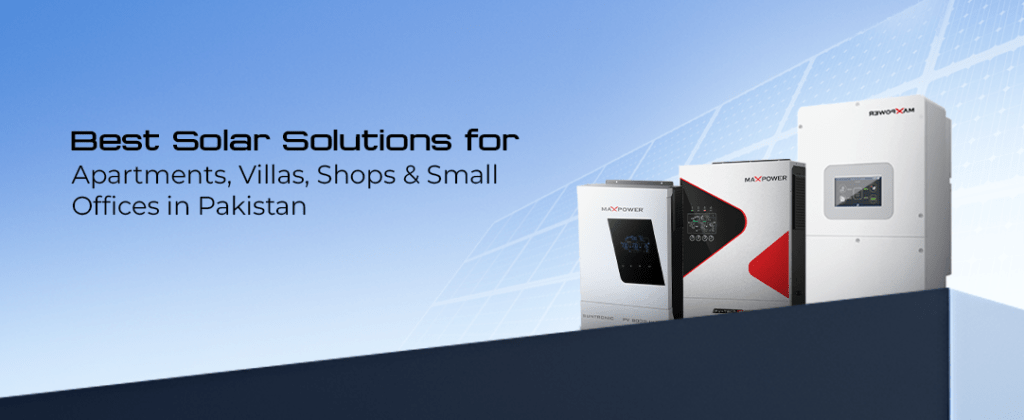
Pakistan’s solar adoption in 2026 has moved well beyond early adopters and large residential properties. Apartment dwellers in Lahore’s DHA and Karachi’s Clifton, small shop owners in commercial markets from Faisalabad to Islamabad, and villa residents in gated communities across the country are all now actively evaluating solar. The buying decisions they face are not the same. A flat in a multi-story building has completely different constraints from a standalone villa. A kiryana shop has different load priorities from a small medical clinic.
Generic solar advice does not serve these buyers well. This guide covers each property type specifically, with honest assessments of what is possible, what is not, and what a correctly sized Max Power system looks like for each context.
Solar Solutions for Apartments in Pakistan
The Challenges and What Is Actually Possible
Apartments present two constraints that standalone properties do not face: limited individual roof access and building society approval requirements. In a multi-story apartment building, the roof is shared. Individual flat owners typically cannot install panels without building management and society approval, and the available rooftop area may already be allocated for water tanks, AC units, and common facility equipment.
Where apartment residents can install solar, the options are the following:
- Balcony or terrace mounting: In upper-floor flats with an accessible balcony or private terrace, a small panel array of 2 to 4 panels can be mounted at an appropriate angle. This limits system capacity to 1 kW to 2 kW, which is sufficient for targeted backup of fans, lights, a router, and a television but not for an air conditioning unit.
- Collective rooftop installation: Some apartment societies have been installing collective rooftop solar systems managed through the building management company, with generation shared proportionally among residents or allocated to common area lighting and elevator power. This model is growing in Lahore and Karachi housing societies and is worth raising with your society management if individual installation is not possible.
- Recommended system for an accessible apartment: Max Power’s Suntronic PV6000 Pro 6kW hybrid at PKR 123,000 paired with the MP-2500 Ultra (2.56 kWh) battery, with 4 to 6 monocrystalline panels on a balcony or terrace mount. This covers essential evening backup for a medium-sized flat through daily load shedding windows without requiring rooftop installation or heavy structural work.
Solar Solutions for Villas and Standalone Houses
The full system is available here.
Villas and standalone houses in Pakistan have the most straightforward solar opportunity. Full rooftop access, no society approval constraints for self-contained systems, and typically the highest household electricity consumption that benefits most from solar offset.
A correctly sized villa solar system in Pakistan covers two objectives simultaneously: daytime bill reduction through net-metering-eligible on-grid generation and evening backup through hybrid inverter and battery storage.
- Small villa or 5-marla home: 6 to 8 monocrystalline panels (3.3 to 4.6 kW), Max Power Suntronic PV6000 Pro 6 kW hybrid inverter, and Max Power MP-2500 Ultra or MP-10000 Alpha battery. System cost range: PKR 600,000 to PKR 900,000 depending on battery capacity.
- Medium villa or 10-marla home: 10 to 14 monocrystalline panels (5.5 to 8 kW), Max Power Voltas 6K-H6 IP66 hybrid inverter at PKR 232,700, and Max Power MP-10000 Alpha (10 kWh) battery. This is the most common configuration for Pakistani urban villa buyers in 2026. A 6 kW hybrid system in Pakistan generates 22 to 30 units daily and saves PKR 1,300 to PKR 1,800 per day at current tariffs.
- Large villa or 1-kanal home: 16 to 20 monocrystalline panels (9.2 to 11.5 kW), Max Power Voltas 10K-H4 single-phase hybrid at PKR 375,000 to PKR 424,000, and Max Power MP-16000 Alpha (16 kWh) battery. For homes with multiple inverter AC units and high evening consumption, the 16 kWh battery provides full-evening backup without running short before the grid returns.
For net metering on villa installations, Max Power handles AEDB registration and DISCO NOC documentation as part of the residential installation package. Details are available at the residential solutions page.
Solar Solutions for Shops and Small Retail Businesses
Load Profiling Is Different From Residential
A shop in Pakistan has a load profile fundamentally different from a home. The load is concentrated during business hours, which aligns well with solar generation hours. Refrigeration, lighting, fans, point-of-sale systems, and one or two air conditioning units are the typical commercial load.
This daytime alignment is solar’s strongest financial case for commercial buyers. A shop that runs 8 hours of AC during the day while solar is generating is using free energy for its most expensive load at exactly the right time. The evening backup requirement is minimal because the shop is closed.
Recommended system for a small shop (kiosk, mobile shop, salon): 4 to 6 monocrystalline panels (2.2 to 3.3 kW), Max Power Suntronic PV6000 Pro kW hybrid at PKR 123,000, MP-2500 Ultra battery for critical loads backup only. System cost range: PKR 350,000 to PKR 500,000. Payback period at current commercial tariffs: 2 to 3 years.
Recommended system for a medium shop (clothing, electronics, pharmacy, small restaurant): 8 to 12 monocrystalline panels (4.4 to 6.9 kW), Max Power Voltas 6K-H4 hybrid at PKR 260,000, and MP-10000 Alpha battery for critical operations backup. System cost range: PKR 700,000 to PKR 1,000,000. These shops save significantly on commercial tariffs and protect refrigerated inventory during outages.
For commercial properties, Max Power’s commercial solar solutions page outlines the full scope of what the commercial installation team covers.
Solar Solutions for Small Offices and Clinics
The Reliability Case Is Stronger Than the Bill Case
For a small office or medical clinic in Pakistan, the financial case for solar is clear, but the operational continuity case is even more compelling. A clinic without power during a consultation or a procedure is a patient safety issue. A law office or accountancy firm that loses power during a client meeting or during tax filing season loses far more than the electricity cost.
Small office or clinic setup: 8 to 12 monocrystalline panels (4.4 to 6.9 kW); Max Power Voltas 6K-H6 IP66 hybrid at PKR 232,700; and Max Power MP-10000 Alpha (10 kWh) or MP-16000 Alpha (16 kWh) depending on backup duration required. The IP66 rating is relevant if the inverter is installed in a semi-exposed plant room or rooftop enclosure rather than a climate-controlled indoor space.
For medical clinics with specific equipment, including dental chairs, diagnostic imaging, or surgical lighting, a load audit before system design is essential. Some medical equipment has surge draw characteristics that require specific inverter surge capacity ratings. Max Power’s commercial team can specify the correct inverter model after reviewing the clinic’s actual equipment list.
The Net Metering Question for All Property Types
Net metering is available in Pakistan for all of these property types under NEPRA’s distributed generation regulations, subject to DISCO capacity availability in your specific area. The grid-connected system must be registered with AEDB and approved by your DISCO before the bidirectional meter is installed.
For apartments with collective systems, net metering credit is assigned to the consuming account, which in a collective setup may be the building management account. For standalone residential and commercial properties, net metering is a standard feature of any on-grid or hybrid solar system installed by Max Power.
The Max Power news and insights section has ongoing guidance on net metering developments, NEPRA framework updates, and solar market trends for Pakistani buyers.
Frequently Asked Questions
Can an apartment resident in Pakistan install solar panels without full rooftop access?
Yes, with constraints. A balcony or private terrace installation of 2 to 6 monocrystalline panels gives an apartment resident 1 kW to 3 kW of solar capacity for essential load backup. Full system performance requires unobstructed sun exposure, which a balcony may not have depending on its orientation. A south-facing terrace or balcony with unobstructed access to morning and afternoon sun is the best option. Max Power can assess your specific apartment’s solar potential before recommending a system.
What is the minimum solar system size worth installing for a small shop in Pakistan?
A 3 kW to 4 kW system is the practical minimum for a small shop that wants meaningful daytime generation and essential load backup during outages. Below 3 kW, the system covers only basic lighting and fans, which is useful but gives a long payback period at commercial tariff rates. A 4 kW to 6 kW system that offsets the shop’s AC load during peak hours delivers the strongest payback for most small commercial retailers in Pakistan.
Is the Max Power Voltas 6K hybrid inverter suitable for a villa with one inverter AC unit?
Yes. The Voltas 6K-H4 or 6K-H6 handles a single 1.5-ton inverter AC unit’s running load of approximately 900W to 1,200W and startup surge of approximately 3,000W to 4,000W well within its rated surge capacity. With a Max Power MP-10000 Alpha battery for evening backup and 10 to 12 monocrystalline panels for daytime generation, this is a complete system for a 10 marla villa at a well-defined budget.
How do I get solar for my small office in Pakistan if I do not own the building?
Tenants in Pakistan can install solar systems with landlord consent and appropriate agreements about ownership of the installed equipment. Most landlords in Pakistan are receptive to solar installation, as it adds property value and reduces tenant electricity costs, which improves tenant retention. A reversible or removable system design, using structures that do not permanently modify the building, is the practical approach for tenants. Max Power’s installation team can design a tenant-appropriate system based on your lease situation.
What is the realistic payback period for a 5 kW solar system for a villa in Pakistan in 2026?
A well-designed 5 kW hybrid solar system for a Pakistani villa, generating 18 to 25 units per day at current tariff rates of PKR 50 to PKR 65 per unit in upper slabs, saves PKR 900 to PKR 1,625 per day, which is PKR 328,500 to PKR 593,125 per year. At a system cost of PKR 900,000 to PKR 1,200,000 including installation and battery, the payback period is 2 to 3.5 years. The remaining 21 to 23 years of system life represent free or near-free electricity generation.
Have you found the right solar solution for your property type yet?
The right solar system for your apartment is not the same as the right system for your villa, your shop, or your clinic. Getting this matching right determines whether solar delivers on its financial promise for your specific situation.
Request a quote from to discuss your property type, your load profile, and your backup requirements with a team that designs systems for Pakistan’s real conditions rather than off-the-shelf packages.