Gas Geyser vs Solar Power Modern Electric Geysers on MaxPower Energy in Pakistan
November 1, 2026
Solar Electric Chulha vs. LPG Gas Cylinder: Monthly Cooking Cost Comparison with Maxpower
August 10, 2026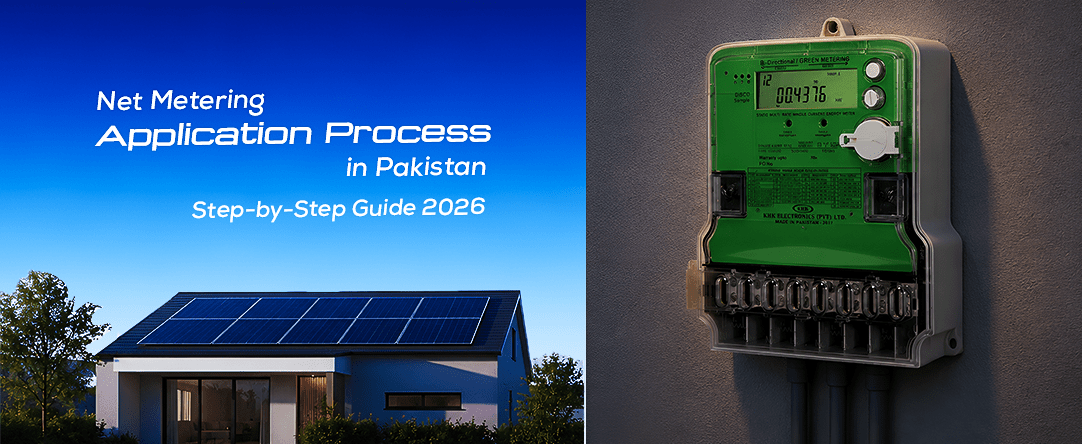
Electricity tariffs in Pakistan have risen sharply over the past three years, and for most property owners the bill now represents a serious monthly expense rather than a routine utility cost. Against that backdrop, net metering has become the most effective way to convert a solar investment into a permanent reduction in electricity spending.
The principle is straightforward. Install a grid-connected solar system, export the surplus your property does not consume during daylight hours, and use those exported units to offset what you draw from the grid at night. Done correctly, the result is a monthly bill reduced to a fraction of its previous level.
What is not straightforward is the process. Net metering in Pakistan runs through the National Electric Power Regulatory Authority (NEPRA) and your local distribution company (DISCO), and it involves technical audits, safety compliance verification, and a documentation chain where a single missing document can delay the file by weeks.
This guide walks through the 2026 process in order, explains what changed in the regulations, and covers the equipment requirements that determine whether your file clears inspection on the first attempt.
What Net Metering Is, and What Changed
Net metering connects your on-grid or hybrid solar system to your local distribution company—LESCO, IESCO, MEPCO, FESCO, GEPCO, PESCO, HESCO, QESCO, SEPCO, or K-Electric depending on your area. A bi-directional meter records two separate figures: the units you import from the grid and the units you export to it.
The most important regulatory development is that the framework has moved from simple one-to-one net metering toward a structured net billing arrangement. Under the NEPRA (Prosumer) Regulations, 2025, units you export are credited at the national average energy purchase price, while units you import are billed at your applicable tariff. Where the export credit exceeds your import charges in a given cycle, the balance carries to the next billing cycle or is settled quarterly.
The practical implication is significant. Because export compensation is lower than retail tariff, the highest financial return now comes from consuming your own solar generation directly—running air conditioners, water pumps, and machinery on solar during the day—rather than exporting everything and buying it back at night. Battery storage reinforces this further, since stored solar used in the evening displaces full-tariff grid units instead of earning a lower export credit. The underlying economics are covered in MaxPower’s guide on how to reduce electricity bills with solar energy.
The second change is enforcement of capacity limits. Your solar system capacity cannot exceed the sanctioned load shown on your electricity bill. This is not a formality—files are routinely returned when the inverter rating exceeds sanctioned load.
Feasibility Audit and System Sizing
Before any application is filed, have a site survey conducted by an AEDB-certified or PEC-registered installer. Two things need to be confirmed at this stage.
The first is sanctioned load. If your connection is rated at 5 kW and you intend to install a 10 kW system, you must apply to your DISCO for a sanctioned load extension first. Net metering cannot be submitted on an undersized connection.
The second is physical and electrical space. Your roof must support the array structurally, and your main distribution board needs room for the AC and DC protection chain—breakers, surge devices, and disconnects. Panel selection matters here as well, since Pakistani rooftop temperatures routinely exceed 60°C in summer and panels with poor temperature coefficients lose output exactly when production is most valuable. The MaxPower solar panel collection covers half-cut and bifacial N-type TOPCon modules selected for heat performance.
For sizing methodology, MaxPower’s guide on how to choose the right solar system size sets out the variables that determine capacity.
Document Preparation
Incomplete paperwork is the single most common cause of rejection and delay. Assemble the following before approaching the DISCO office.
You will need a copy of the CNIC of the electricity bill owner, paid copies of the last three months’ bills, and proof of property ownership—registry, fard, or allotment letter.
On the technical side, you need a single line diagram showing the PV array, inverter, grounding, and protective devices, signed by a registered engineer. You also need manufacturer datasheets for the panels and the inverter, demonstrating certification appropriate to grid interconnection.
Finally, a signed contract between you as prosumer and the certified installer is required. The application is normally submitted through the installer rather than by the owner directly.
Submission to the DISCO
Your installer submits the complete file to the relevant DISCO office—typically the Executive Engineer or Sub-Divisional Officer for your area. A processing fee voucher is issued at this stage.
The DISCO’s technical team then reviews feeder capacity. Distribution transformers carry export limits, commonly in the region of 80% of transformer capacity, to prevent localised over-voltage. If your feeder is already saturated with solar exports, the application may be held regardless of the quality of your documentation.
Technical Inspection and NOC
A DISCO inspection engineer visits the site to verify safety compliance. Three items are checked closely.
Anti-islanding protection comes first. The inverter must disconnect from the grid immediately when supply fails, protecting line workers from back-feed. This is a certified function, not an optional setting, and grid-compliant hybrid units are listed in the MaxPower hybrid solar inverter range.
Grounding and surge protection come second. Dedicated earthing pits for both AC and DC sides are expected, along with surge protection devices and moulded case circuit breakers.
On successful inspection the DISCO issues a No Objection Certificate and the grid interconnection agreement is signed.
NEPRA Generation Licence
The signed agreement and NOC are forwarded to NEPRA, which issues the Distributed Generation Licence registering your system as an official prosumer facility. NEPRA’s published regulations set out the application requirements, the per-kilowatt fee, and the format of the interconnection agreement.
Bi-Directional Meter Installation
Once the licence is confirmed, the meter fee voucher is paid and the DISCO testing laboratory tests and seals the bi-directional smart meter. Technicians then remove your existing unidirectional meter and install the new import/export unit.
Commissioning and Billing Activation
With the meter installed, the system is energised and your consumer profile is updated in the billing database. From the next cycle onward, your bill separates imported units, exported units, and the net payable or credit balance under the applicable tariff.
What It Costs and How Long It Takes
Typical timings in Pakistan run from 30 to 60 days end to end, though DISCO workload and NEPRA processing speed cause wide variation, and feeder-level constraints can extend this considerably.
The DISCO application and processing voucher is a modest fee in the low thousands of rupees. Engineering work for the single line diagram and inspection typically falls in the range of Rs. 5,000 to Rs. 10,000. The approved bi-directional smart meter generally costs between Rs. 25,000 and Rs. 45,000. Protection equipment—surge devices, breakers, and earthing—runs Rs. 35,000 to Rs. 70,000 depending on system size and earthing conditions.
In total, the net metering setup alone usually comes to roughly Rs. 75,000 to Rs. 130,000, excluding the solar system itself.
Protection Equipment Checklist
To clear inspection on the first visit, the installation must include a grid-tie or hybrid inverter with certified anti-islanding capability, a DC disconnect switch and Type 2 surge protection devices between the array and inverter, a dedicated MCCB or MCB between the inverter output and the main distribution board, and independent earthing for the PV frame structure and the inverter neutral, with resistance measured below 5 ohms.
The MaxPower inverter catalog covers both hybrid and on-grid platforms suitable for net-metered sites, and complete matched systems are listed on the MaxPower products page.
Adding Battery Storage to a Net Metered System
Net metering and battery backup are not alternatives. A hybrid inverter allows both: it exports surplus to the grid while the grid is up, and continues powering essential circuits from stored energy during load shedding. Given that export credits are now lower than retail tariff, the battery also improves returns, because evening consumption drawn from stored solar avoids full-tariff import entirely.
LiFePO4 storage is the appropriate chemistry for Pakistani conditions—6,000 to 8,000 cycles, up to 90% usable depth of discharge, and no maintenance requirement. Options are listed in the MaxPower lithium battery range, and the runtime arithmetic is set out in the guide on how to calculate battery backup hours. For a broader comparison of inverter and battery pairings, see the best inverter and lithium battery combinations for MEA buyers and the Growatt vs MaxPower comparison.
Conclusion
Net metering in Pakistan remains one of the strongest financial cases available to a property owner, but the return now depends on design discipline—right-sizing against sanctioned load, maximising daytime self-consumption, and specifying equipment that passes DISCO inspection without rework.
MaxPower supplies grid-compliant hybrid inverters, heat-resistant solar modules, and LiFePO4 storage built for these conditions, with technical support through sizing, documentation, and interconnection. Browse the full range on the MaxPower product catalog, or review the commercial systems guide for larger properties in the complete guide to commercial solar systems.
Frequently Asked Questions
How long does net metering approval take in Pakistan?
Typically 30 to 60 days from submission to meter installation. DISCO workload, NEPRA licensing speed, and local transformer export capacity all affect the timeline, and saturated feeders can extend it significantly.
Can net metering be applied on a single-phase connection?
Generally not. NEPRA’s prosumer framework addresses three-phase 400V and 11kV consumers. A single-phase connection usually requires an upgrade to three-phase with the DISCO before an application can proceed.
What happens to exported units at the end of the billing cycle?
Exported units are credited against imported units at the national average energy purchase price under the current net billing arrangement. Any net credit carries forward to the next cycle or is settled quarterly.
Why do DISCOs reject net metering applications?
The usual reasons are inverter capacity exceeding sanctioned load, applications submitted through non-certified vendors, missing surge protection or inadequate earthing, incomplete single line diagrams, and feeder-level capacity saturation.
Does installing a battery affect net metering eligibility?
No. A hybrid inverter can export surplus to the grid while the grid is available and switch to battery power during outages. Battery storage is compatible with net metering and, at current export credit rates, generally improves overall returns.