Fuel Price Increase? Invest Once in Solar System and Reduce Electricity Costs in Pakistan
September 25, 2026
MaxPower Solar Solutions for Hostels, Hotels & Large Homes in Pakistan – Hybrid Inverters & Lithium Batteries
October 10, 2026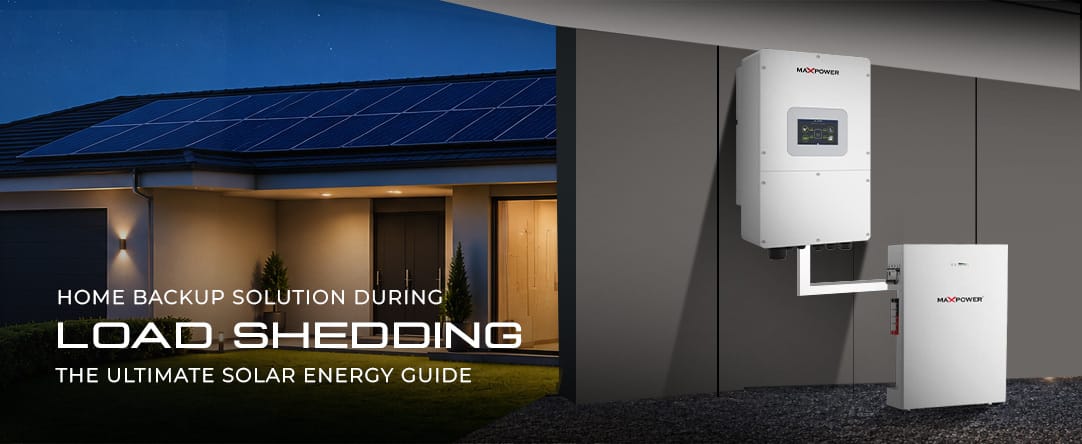
Load Shedding Solution for Homes in Pakistan: Hybrid Solar with Lithium Backup
Load shedding in Pakistan is no longer a seasonal inconvenience. For most households it is a daily reality—four to eight hours of outages on urban feeders, longer on rural circuits, and always at the worst possible time. Combined with repeated tariff increases and slab-based billing, the result is that families pay more for electricity while receiving less of it.
The usual response has been a fuel generator or a lead-acid UPS. Both worked reasonably well ten years ago. Today, neither makes financial or practical sense.
This guide explains why the hybrid solar system with lithium battery storage has become the standard residential solution in Pakistan, how it performs during different outage conditions, and how to size one correctly for your home.
Petrol and diesel generators carry three problems that cannot be engineered away. The first is fuel cost—running a 5 kVA generator for five hours daily can add tens of thousands of rupees to your monthly expenses before you count oil changes and servicing. The second is maintenance. The third is noise and exhaust, which is difficult to justify in a dense residential neighbourhood.
Gas generators have their own limitation. Low gas pressure during winter load-management periods often makes them unusable exactly when you need them.
Conventional UPS systems with tubular or lead-acid batteries fail differently. They work initially, then degrade quickly. Under daily double-cycle outages in Pakistani summer temperatures, most tubular batteries lose meaningful capacity within twelve to eighteen months. Because lead-acid chemistry cannot be discharged below roughly 50% without permanent damage, a nominally large battery delivers far less usable energy than its rating suggests. And recharging them is slow and lossy—consuming grid electricity for eight to ten hours just to be ready for the next outage.
A hybrid solar system connects three things at once: solar panels on the roof, a lithium battery bank, and the utility grid through your DISCO connection. The hybrid inverter is the component that decides, moment by moment, where power should come from and where it should go.
In normal daytime conditions, the inverter runs your home directly from solar generation. Anything left over charges the battery, and any remaining surplus can be exported to the grid under a net-metering arrangement.
When the grid fails during the day, the inverter disconnects from the utility line for safety and continues running the house from solar. If your appliances draw more than the panels are producing—say, an air conditioner cycles on under cloud cover—the inverter covers the gap from the battery. Power to your home does not stop.
When the grid fails at night, the inverter draws from the battery. Switching happens within milliseconds, fast enough that computers, routers, and inverter air conditioners do not restart or reset.
Under the current NEPRA Prosumer Regulations, exported units are credited against your consumption at the national average energy purchase price, and any net credit carries to the following billing cycle.
This is also why a hybrid system works during outages while a standard on-grid system does not. On-grid inverters must shut down completely when the grid fails—an anti-islanding requirement designed to protect utility workers. Your panels keep producing nothing usable, even in bright sunshine.
Getting the sizing right is the difference between a system that quietly works for a decade and one that either trips under load or costs more than it needed to.
A practical approach is to size the inverter for peak simultaneous load, not average consumption. A five to seven marla home running lights, fans, a refrigerator, a television, and one 1.5-ton inverter AC typically needs a 6 kW hybrid inverter. A ten marla to one kanal home with two inverter ACs, a freezer, and a water pump generally needs 8 kW to 10 kW. Larger homes and villas with three or more ACs and submersible pumps move into the 12 kW to 20 kW range, often on three-phase equipment.
Battery sizing follows a separate calculation. Take your essential evening load in kilowatts, multiply by the hours of backup you want, and divide by the usable depth of discharge. A 4 kW essential load across six hours requires 24 kWh of usable energy, which means roughly 30 kWh of rated lithium capacity at 80% usable depth. You can work through the full formula in Maxell Power’s guide on how to calculate battery backup hours, and the broader sizing logic is covered in how to choose the right solar system size for your home.
For most Pakistani households, this puts the practical setup at a 6 kW to 10 kW hybrid inverter paired with 5 kWh to 16 kWh of lithium storage.
The inverter is the most important purchase decision. Look for dual MPPT trackers, which matter on roofs where panels face different directions or where shading moves across the day, and for native CAN or RS485 communication with the battery management system. That communication link is what allows the inverter to control charge current and voltage precisely rather than guessing at them. The Maxell Power hybrid solar inverter range includes single-phase and three-phase options across residential and commercial capacities, and the full inverter catalog covers on-grid models as well.
Solar panels should be selected for heat performance, not just headline wattage. Rooftop surface temperatures in Punjab and Sindh routinely exceed 60°C in June, and a panel with a poor temperature coefficient will lose a meaningful share of its rated output precisely when production matters most. Half-cut monocrystalline and bifacial N-type TOPCon modules handle this better. Options are listed in the Maxell Power solar panel collection.
The battery deserves the most attention on lifecycle cost. LiFePO4 chemistry delivers 6,000 to 8,000 cycles before falling to 80% capacity, tolerates up to 90% depth of discharge, recharges in two to three hours of good sunlight, and requires no water top-ups or terminal maintenance. Over a ten-year horizon that replaces four or five successive tubular battery banks. Current LiFePO4 options, including low-voltage and high-voltage units, are listed in the Maxell Power lithium battery range. If you are comparing brands before deciding, this breakdown of the best inverter and lithium battery combinations for MEA buyers is a useful reference, as is the Growatt vs Maxell Power comparison.
One practical note: buy the components as a matched set from one supplier. Mismatched voltage parameters between an inverter and a battery bank cause premature shutdowns and are the single most common cause of underperforming residential systems. Maxell Power’s complete product catalog is built around ensuring that modules, inverters, and storage communicate correctly with each other, and the inverter and lithium battery setup guide walks through correct installation practice.
System capacity is fixed once installed, but runtime is not. Three decisions make a real difference.
Separating essential and non-essential circuits is the first. Water heaters, electric ovens, and other high-resistance loads should sit on a non-backed-up panel so they drop out automatically during an outage instead of draining your battery in twenty minutes.
Choosing inverter-driven appliances is the second. A DC inverter air conditioner draws considerably less continuous power than a fixed-speed unit and eliminates the heavy compressor startup surge, which extends runtime by hours on the same battery.
Setting the discharge floor correctly is the third. Configuring the inverter to stop discharging at 15% to 20% state of charge preserves an emergency buffer without sacrificing everyday efficiency.
The upfront cost of a hybrid solar system with lithium storage is higher than a basic UPS or a small on-grid array. The lifecycle comparison is what matters.
A household following the conventional path replaces its tubular battery bank every eighteen months to two years, pays for generator fuel and servicing through every summer, and continues absorbing tariff increases on the full bill. A household on hybrid solar pays once for a battery that lasts ten years or more, buys no fuel, and reduces its grid consumption by 70% to 90%. In most cases the system recovers its capital cost within three and a half to five years, after which the electricity it produces is effectively free for the remaining fifteen to twenty years of system life, with net-metering export credits adding to the return. The underlying principles are set out in Maxell Power’s guide on how to reduce electricity bills with solar energy.
The context is worth noting: Pakistan has become one of the fastest-growing distributed solar markets in the world, with rooftop installations expanding far faster than official net-metering statistics capture.
World Resources Institute Pakistani households have already made this calculation at scale.
Load shedding is a structural feature of the Pakistani grid and is unlikely to disappear in the near term. What households can control is how much it costs them.
A hybrid solar system combining high-efficiency panels, a pure sine wave hybrid inverter, and LiFePO4 lithium storage removes the outage problem entirely, eliminates fuel expenditure, and cuts the monthly bill to a fraction of its previous level. The equipment is mature, the sizing methodology is well established, and the financial case has already been proven across hundreds of thousands of Pakistani rooftops.
Maxell Power supplies climate-tested panels, hybrid inverters, and lithium storage built for exactly these conditions, with technical support for sizing and system design. Contact the Maxell Power team to have a system configured against your actual household load.
Frequently Asked Questions
What is the best backup solution for load shedding in a Pakistani home?
A hybrid solar system with a pure sine wave hybrid inverter and a LiFePO4 lithium battery bank. It switches to backup within milliseconds, recharges from daylight rather than the grid, and reduces the monthly electricity bill at the same time.
Can a 6 kW to 10 kW system run an inverter AC during an outage?
Yes. A 6 kW to 10 kW hybrid inverter paired with 10 kWh to 16 kWh of lithium storage will start and run one or two inverter ACs alongside lights, fans, and refrigeration. Inverter ACs ramp their compressors gradually, so they avoid the startup surge that fixed-speed units place on the battery.
How many backup hours will a 10 kWh lithium battery provide?
At an 800 W essential load—lights, fans, router, television, refrigerator—roughly ten hours. With one 1.5-ton inverter AC running, expect around four hours. Runtime scales directly with load, so separating essential circuits is the simplest way to extend it.
Why choose lithium over tubular batteries for load shedding backup?
Lithium lasts ten years or more against eighteen to twenty-four months for tubular units in Pakistani summer conditions, gives up to 90% usable capacity against 50%, recharges in two to three hours against eight to ten, and needs no maintenance.
How does a hybrid system differ from on-grid during load shedding?
An on-grid inverter must shut down when the grid fails, to prevent back-feeding the utility line. A hybrid inverter disconnects from the grid and continues supplying the house from solar and battery.
Is a hybrid system compatible with NEPRA net metering?
Yes, subject to the applicable regulations and DISCO approval. Surplus generation is exported through a bidirectional meter and credited against consumption, with unused credit carried forward or settled quarterly.