How Many Solar Panels Does a 5 Marla House in Pakistan Actually Need?
September 14, 2026
How to Clean Solar Panels for Maximum Output in Pakistan
September 6, 2026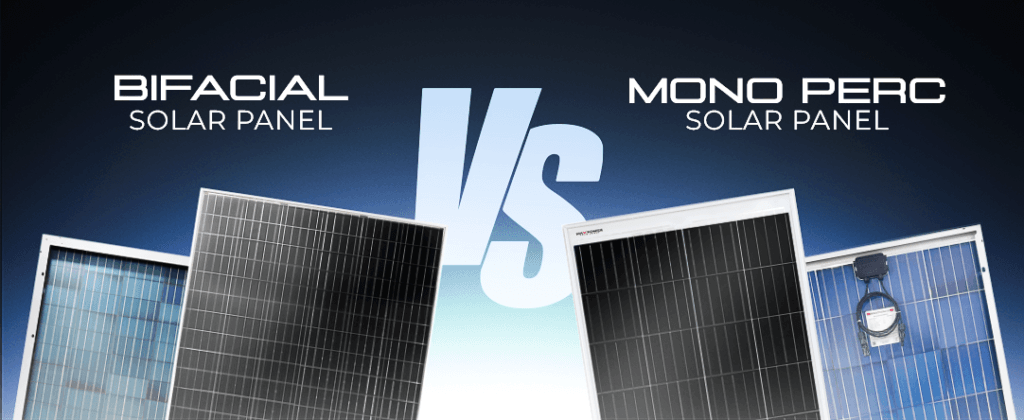
Both bifacial and Mono PERC (Passivated Emitter and Rear Cell) panels are monocrystalline technologies. Both achieve higher efficiency than polycrystalline panels. Both are widely available in Pakistan’s market in 2026 from Tier 1 manufacturers. The difference between them is in how they generate electricity, how their performance compares under Pakistan’s specific climate and installation conditions, and which one gives better return on investment for different types of installations.
This comparison covers what actually matters for Pakistani buyers making this choice in 2026.
What Mono PERC Technology Does
The Standard for Pakistani Residential Solar
Mono PERC panels add a passivation layer to the rear of the solar cell that reflects unabsorbed photons back through the cell for a second capture attempt. This improves efficiency by 0.5% to 1.5% compared to standard monocrystalline panels without PERC treatment.
In practical terms, Mono PERC panels in 2026 achieve 19% to 22% efficiency under standard test conditions. They generate electricity from the front face only. Their performance in high-temperature conditions is improved over polycrystalline by the monocrystalline cell structure, with temperature coefficients typically at 0.35% per degree Celsius above 25°C.
Mono PERC panels are currently the dominant technology in Pakistan’s residential solar market. They are well-understood by installers, widely stocked by distributors, and available at competitive prices from Tier 1 brands. Max Power’s solar panel range includes Mono PERC options for residential and commercial applications.
What Bifacial Technology Does
The Generation Advantage Explained
Bifacial panels generate electricity from both the front and rear faces. The rear face captures reflected light (albedo) from surfaces below and around the panel. On a white or light-colored flat rooftop typical of Pakistani construction, the rear face can capture an additional 5% to 30% of energy compared to front-face generation alone, depending on the surface reflectivity and panel mounting height.
Under standard test conditions (front face only), bifacial panels achieve 20% to 24% efficiency. When the bifacial gain from rear-face generation is included in a real-world installation with appropriate ground clearance and a reflective surface below, effective system output can be 10% to 25% higher than an equivalent Mono PERC system of the same rated wattage.
The key variable is installation environment. The bifacial gain depends on:
- Albedo of the surface below the panels: White-painted concrete rooftops common in Pakistani construction reflect 25% to 40% of incident light. Sand and soil reflect 10% to 25%. Dark rooftop waterproofing membranes reflect under 10%.
- Panel clearance from the roof surface: Bifacial panels need at least 20 to 30 cm of clearance between the panel rear and the roof surface for rear-face light to reach the cells effectively. Ground-mounted installations with full clearance gain the most.
- Panel tilt angle: Higher tilt angles increase the angular exposure of the rear face to reflected light, improving bifacial gain. Flat-mounted panels on flat rooftops gain less from bifacial technology than tilted installations.
Which Performs Better in Pakistan’s Specific Conditions
The Honest Comparison
For a flat rooftop installation on Pakistani white concrete with panels mounted at a 10 to 15 degree tilt and 20 cm minimum clearance, bifacial panels deliver a genuine 8% to 15% additional energy output compared to equivalent mono PERC panels. At a 10% bifacial gain on a 5 kW system generating 20 kWh per day, bifacial adds 2 kWh per day. At PKR 60 per unit over a year, that is PKR 43,800 in additional annual generation value.
For a rooftop with a dark waterproofing membrane, mounting structure directly on the roof surface, or panels mounted flush without clearance, the bifacial gain drops to near zero and Mono PERC provides equivalent performance at potentially lower cost.
For ground-mounted installations in agricultural or open-area settings common in Pakistan’s commercial solar and farming contexts, bifacial panels deliver the strongest performance advantage with full clearance, high-albedo soil or sand, and tilted mounting.
The Price Comparison in Pakistan 2026
Mono PERC panels from Tier 1 brands are available in Pakistan at approximately PKR 28 to PKR 35 per watt. Bifacial panels from the same Tier 1 manufacturers carry a premium of approximately 5% to 15%, putting them at PKR 30 to PKR 40 per watt.
For a 5 kW system at 5,000 W, the price difference between Mono PERC at PKR 32 per watt and bifacial at PKR 37 per watt is PKR 25,000. If the installation conditions provide a 10% bifacial gain worth PKR 43,800 per year in additional generation, the premium pays back in under one year.
If the installation conditions provide minimal bifacial gain, the premium is a cost without a corresponding benefit.
According to industry research, bifacial modules typically deliver around 5% to 15% higher annual energy yield than comparable mono-facial panels, but the actual gain depends heavily on installation factors such as roof reflectivity, mounting height, spacing, and rear-side light exposure. This means the financial advantage of bifacial technology is not automatic — it is achieved only when the site conditions allow the rear side of the panel to contribute meaningful power generation.
The Decision
- Choose Mono PERC when the installation is on a dark rooftop, panels are mounted near-flush to the surface, the rooftop has obstructions limiting rear-face light access, or the budget is the primary constraint.
- Choose bifacial when the installation is on white concrete or a light-colored surface with 20 cm or more of rear clearance; the installation is ground-mounted with a high-reflectivity ground surface; or the system is large enough that the additional generation value clearly justifies the premium.
Browse Max Power’s solar panel range for currently available panel technologies and ask the team which type is appropriate for your specific rooftop conditions.
Frequently Asked Questions
Is bifacial better than Mono PERC for Pakistani rooftop solar?
It depends on your rooftop. If your rooftop is white concrete with panels mounted at a tilt with clearance underneath, bifacial adds 8% to 15% more energy. If your rooftop is dark or panels are mounted flush, Mono PERC and bifacial perform similarly. The installation environment determines which technology delivers better value.
What efficiency do Mono PERC and bifacial panels achieve in Pakistan?
Mono PERC panels achieve 19% to 22% efficiency under standard test conditions. Bifacial panels achieve 20% to 24% under standard test conditions plus an additional 5% to 25% rear-face generation gain in real-world installation conditions depending on the surface albedo and clearance height below the panel.
Do bifacial panels cost more than Mono PERC in Pakistan?
Yes. Bifacial panels carry a 5% to 15% price premium over comparable Mono PERC panels from the same Tier 1 manufacturers. For most Pakistani residential installations with good white concrete rooftops and tilted mounting, this premium is recovered within one year through additional generation.
What is the temperature performance of bifacial vs. mono PERC in Pakistani summers?
Both bifacial and Mono PERC panels are monocrystalline technologies with similar temperature coefficients of approximately 0.35% per degree Celsius above 25°C. Neither technology has a meaningful advantage over the other specifically for heat performance. The performance difference between the two comes from the bifacial rear-face generation advantage, not from temperature handling.
Does Max Power supply bifacial solar panels in Pakistan?
Max Power’s solar panel range includes options across current panel technologies for residential and commercial applications. For a panel type recommendation specific to your rooftop conditions and system requirements, contact Max Power for a consultation.
Have You Matched the Right Panel Technology to Your Rooftop Before Deciding?
The bifacial vs. mono PERC decision is not about which technology is universally better. It is about which technology delivers better energy output in your specific installation environment. Answering that question correctly before purchasing saves you either the cost of the bifacial premium on a rooftop that cannot use it or the generation loss of choosing Mono PERC on a rooftop where bifacial would have added 15% more free energy every day.
Book a call with Max Power today and get expert advice on selecting the right solar panel technology for your rooftop and energy goals.