Diesel Generator vs Solar System – Which Saves More Money?
August 1, 2026
On-Grid vs Off-Grid Solar System in Pakistan – Complete Guide 2026
October 10, 2026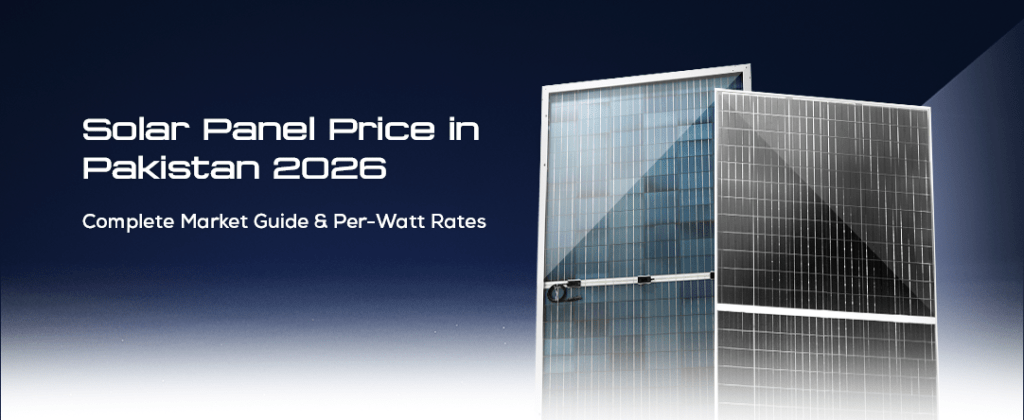
The average solar panel price in Pakistan in 2026 generally ranges from Rs. 37.5 to Rs. 48 per watt for A-grade modules, depending on manufacturer, cell technology, frame construction, and warranty terms. Premium Tier-1 brands using N-Type technology sit at the upper end of that band because they deliver higher conversion efficiency, better temperature coefficients, and slower annual degradation across a 25-year service life.
Prices do fluctuate with the USD-to-PKR exchange rate, ocean freight, and international silicon supply, but modules remain substantially cheaper today than they were even two years ago. For Pakistani buyers, that combination of falling hardware cost and rising grid tariffs has created an unusually favourable window to invest.
Pairing modern N-Type TOPCon and bifacial modules with high-efficiency inverters and lithium storage from MaxPower solar energy solutions ensures maximum output per square metre, faster capital recovery, and durable protection against future utility tariff increases. One note before the numbers: everything below is an indicative market rate, not a fixed quotation. Confirm current pricing with your dealer or engineer before committing to a purchase order.
Updated Solar Panel Rates Per Watt in Pakistan
Solar panel rates are quoted on a per-watt basis rather than per panel, because wattage ratings now span 525W to 700W within the same price bracket. That makes per-watt comparison the only reliable way to evaluate competing offers. Rates vary primarily by cell technology — N-Type TOPCon, HPBC, or HJT — along with frame construction, double-glass bifacial configuration, and whether the module carries genuine distributor warranty documentation.
Tier-1 Premium (LONGi Hi-MO X10 with HPBC 2.0, AIKO ABC, Risen Hyper-ion HJT) commands Rs. 43 to Rs. 48 per watt. These modules use back-contact architectures with anti-shading optimisation and excel where roof space is tight or partial shading is unavoidable. For a single 585W to 640W module, expect roughly Rs. 25,000 to Rs. 30,700.
Tier-1 Standard (Jinko Tiger Neo, JA Solar DeepBlue, Trina Vertex N) is the dominant workhorse for Pakistani rooftops and trades at Rs. 39.5 to Rs. 43.5 per watt. These are N-Type TOPCon bifacial dual-glass modules offering 21% to 22.5% efficiency with strong performance under high ambient heat. A single 585W to 640W module lands between Rs. 23,000 and Rs. 27,800.
Budget and value A-grade (Crown, Jesko, Astronergy) sits at Rs. 37.5 to Rs. 41 per watt, or roughly Rs. 22,000 to Rs. 26,200 per 585W to 640W module. These are typically N-Type TOPCon with steel or lighter aluminium frames. They can be a legitimate value pick for large ground-mounted arrays where structural loading permits, but verify serial numbers and warranty registration carefully.
Beyond these three tiers sits local and Tier-2 stock at roughly Rs. 28 to Rs. 33 per watt. This segment is where the Pakistani market carries genuine risk: re-stamped wattage labels, mismatched serial numbers, and warranty claims that cannot be honoured. If a quote lands dramatically below Rs. 37 per watt for a supposedly Tier-1 module, the discount is almost always being funded by something you cannot see.
An important structural point: these are wholesale module-only rates for A-grade panels. A complete installed system also carries the mounting structure, DC and AC cabling, protective devices, earthing, labour, and the inverter — which is why package pricing differs so widely between installers quoting the “same” system size.
Popular Solar Panel Brands Available in Pakistan
Pakistan’s market carries several internationally recognised manufacturers whose modules are widely stocked and serviced. Jinko Solar, LONGi Solar, JA Solar, Canadian Solar, Trina Solar, Risen Energy, Astronergy, and Tongwei (TW Solar) all maintain distribution across Karachi, Lahore, and Islamabad.
Beyond imported brands, MaxPower supplies its own panel line engineered for the region’s heat, dust, and irradiance profile. The MaxPower solar panel range includes the Bifacial 525W Half Cut module with 144 half-cut cells, 48.95V open-circuit voltage, and a 5,400 Pa front load rating, alongside a Bifacial 280W module for compact rooftops and a Mono 210W/220W bifacial module for small or irregular installations. Full technical specifications are published under the MaxPower panel category, and guidance on matching modules to inverter and battery architecture is available in how to choose the right products for solar installation.
Residential Applications: Maximising Output on Limited Roof Space
For Pakistani homes, the binding constraint is almost never budget — it is shade-free roof area. A typical 5-marla house has room for perhaps 10 to 14 panels, which is why high-wattage 585W to 640W N-Type modules matter so much: they extract more kilowatt-hours from the same square metres, and they do it during the hottest part of the day when air-conditioning load peaks.
Households are therefore combining these high-efficiency modules with MaxPower hybrid inverters to run heavy inductive loads smoothly through both load shedding and the summer peak. A well-matched 5kW to 6kW hybrid setup uses eight to ten panels and suits a 5-marla to 10-marla home running one or two inverter air conditioners, a refrigerator, fans, and lighting, with enough battery reserve to carry critical circuits through a typical outage window.
For larger villas in the 10kW to 20kW range, high-voltage architecture becomes the better engineering choice. High-voltage MaxPower systems, including the Voltas HYD series and the HP-5000-H battery platform, run at substantially higher DC bus voltages than 48V systems. The practical benefits are real: lower current means thinner copper cabling across long roof runs, less resistive line loss, and a smaller equipment footprint — all of which matter when you are powering central cooling across a 1-Kanal property. The MaxPower hybrid inverter range and the MaxPower inverter comparison guide set out the differences between the Suntronic, PV Tech, and Voltas lines.
Commercial and Industrial Applications: Escaping the Diesel Trap
Factories, commercial plazas, hospitals, and warehouses carry a cost burden households do not: when the grid fails, they must run high-horsepower diesel generators, and the fuel bill for that decision is brutal. At current diesel prices, generator electricity costs roughly Rs. 100 to Rs. 126 per unit — two to three times the grid tariff.
A modern commercial installation replaces most of that runtime rather than merely offsetting a bill. Large-format bifacial arrays generate free daytime power across the full production shift, while commercial-grade high-voltage hybrid inverters coordinate grid, solar, battery, and generator inputs within a single architecture.
MaxPower’s heavy-duty commercial platform, including the HYD-40K-H6 and the 100K-HYD-H6 and 125K-HYD-H6 three-phase high-voltage hybrid inverters, supports simultaneous grid, solar, and generator inputs with dual MPPT tracking and parallel clustering for multi-unit scaling. High-voltage architecture keeps battery banks compact because fewer parallel strings and lower current are required for the same stored energy — a genuine advantage when roof or plant-room space is already committed to machinery. Storage options are detailed in the MaxPower lithium battery catalogue, and full project planning guidance is covered in the complete guide to commercial solar systems.
On returns: a well-engineered three-phase commercial installation with high daytime self-consumption typically recovers its capital in roughly two-and-a-half to four years, depending on tariff category, load profile, and how much generation is consumed on site versus exported. Larger industrial systems at 100kW and above often land at the faster end because per-watt installation cost falls with scale and daytime load coverage is higher.
Agricultural Applications: Replacing Diesel and Petrol Engines at the Tubewell
Pakistani farmers absorb the sharpest impact of fuel price volatility, because tubewell irrigation is entirely diesel or petrol dependent in most of Punjab and Sindh. Every rupee added to diesel lands directly on crop cost, and rural feeders frequently fail exactly when irrigation is most needed.
Solar pumping inverters solve this cleanly. Using Variable Frequency Drive technology, MaxPower pumping inverters convert direct solar DC power into three-phase AC to drive agricultural water pumps across the CHF200 range, spanning 4kW to 75kW models including the CHF200-7R5-4-PV at 7.5kW and the CHF200-015-4-PV at 15kW. The result is uninterrupted, fuel-free irrigation through daylight hours, with no dependence on rural load-shedding schedules.
Soft-start VFD functionality also protects expensive submersible pumps from the voltage surges and dry-run conditions that destroy motors — an underappreciated benefit, since a burnt-out submersible is one of the largest unplanned expenses a small farm faces. The full pumping inverter lineup sits within the MaxPower product directory.
Key Factors Affecting Solar Prices in 2026
Cell technology drives the per-watt premium. N-Type TOPCon and ABC modules cost slightly more than older Mono PERC stock, but they convert more sunlight per square metre and degrade more slowly — roughly 0.4 percent annually against 0.55 percent for PERC — which compounds into meaningfully more lifetime yield in a country where summer rooftop temperatures exceed 65°C.
Enclosure ratings matter just as much for the balance of system. Inverter and battery IP ratings determine where equipment can safely live. Indoor plant rooms can accept IP20 and IP21 rated equipment, while outdoor or semi-exposed installations require IP65 or IP66 enclosures. MaxPower makes this choice explicit on storage: the HP-5000-H high-voltage battery is available in both an IP65-rated version for exposed installations and an IP20-rated version for indoor plant rooms, while the MP-10000 Ultra and MP-32000 Ultra are indoor-rated units with CAN, RS485, and RS232 communication.
Documentation quality is the third factor, and it is where most buyers lose money. Insist on visible serial numbers, an official distributor warranty registration in your own name, and an invoice that names the exact model rather than a generic wattage. B-grade and re-stamped stock circulates widely in the Pakistani market, and it rarely fails within the first year — which is precisely why it escapes detection until the warranty claim.
What Actually Drives Your Payback in 2026
Payback calculations circulated in older Pakistani solar content assumed one-for-one net metering, where every exported unit earned the full retail tariff. That framework no longer applies to new connections.
Under NEPRA’s Prosumer Regulations 2026, new distributed generation connections operate on net billing. Units imported from the grid are charged at your applicable retail tariff, while exported units are credited at the national average energy purchase price, currently in the region of Rs. 10 to Rs. 13 per unit. Connections approved before February 2026 retain their original terms until those agreements expire.
The practical implication is straightforward: self-consumed solar is now worth three to four times as much as exported solar. A system sized to your daytime load, ideally paired with battery storage to shift midday generation into evening use, captures the full retail tariff on nearly every unit produced. A system oversized for export does not.
A complete 5kW on-grid installation currently runs roughly Rs. 580,000 to Rs. 750,000, while a 5kW hybrid configuration with lithium storage lands between Rs. 850,000 and Rs. 1,200,000 depending on battery capacity and inverter class. Pair that with realistic payback guidance — three to four years for a well-sized system with strong daytime self-consumption — and the investment case remains compelling without relying on inflated promises. Sizing methodology is detailed in how to choose the right solar system size, runtime arithmetic in how to calculate battery backup hours, broader bill-reduction strategy in how to reduce electricity bills with solar energy, and physical install guidance in the inverter and lithium battery setup guide.
Frequently Asked Questions
What is the average solar panel price in Pakistan in 2026?
A-grade modules trade between Rs. 37.5 and Rs. 48 per watt depending on tier. Tier-1 standard N-Type TOPCon modules sit at Rs. 39.5 to Rs. 43.5 per watt, premium HPBC and HJT modules at Rs. 43 to Rs. 48, and value A-grade stock at Rs. 37.5 to Rs. 41. Local and Tier-2 modules fall to Rs. 28 to Rs. 33 per watt, though documentation quality in that segment requires careful verification.
Which solar panel brand is best in Pakistan?
Jinko Solar, LONGi Solar, JA Solar, Canadian Solar, Trina Solar, Risen Energy, Astronergy, and Tongwei are all widely available and serviceable. For Pakistan’s climate, the more useful selection criterion is the temperature coefficient — anything at or below minus 0.40 percent per degree Celsius performs noticeably better through Punjabi and Sindhi summers than modules with a weaker coefficient.
How much does a 5kW solar system cost in Pakistan?
An on-grid 5kW installation runs roughly Rs. 580,000 to Rs. 750,000 fully installed. A hybrid 5kW configuration with lithium battery backup ranges from Rs. 850,000 to Rs. 1,200,000, with the variance driven mainly by battery capacity, inverter class, mounting structure type, and whether DISCO net billing processing is included.
Is Mono PERC or N-Type better for Pakistani conditions?
N-Type TOPCon generally wins on efficiency, degradation rate, and temperature performance. PERC remains a defensible budget choice where roof space is abundant and upfront cost dominates the decision, but the price gap has narrowed enough in 2026 that N-Type is usually the better lifetime value for residential and commercial rooftops.
Why choose MaxPower solar energy solutions?
MaxPower supplies panels, hybrid and on-grid inverters, high-voltage and low-voltage LiFePO4 storage, and solar pumping inverters as a matched equipment set rather than mismatched components from different vendors. That matters in practice: correct inverter-to-battery communication, consistent warranty accountability, spare parts availability, and technical support across Pakistan are what protect the system years after installation. To discuss a configuration for your roof, load profile, or tubewell, reach the team through the MaxPower contact page.