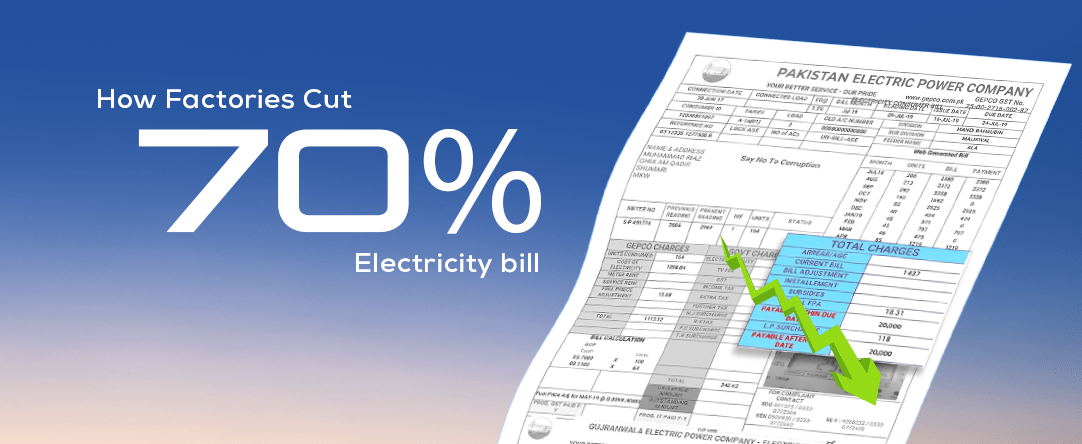
How Factories Can Reduce Electricity Bills by 70% with MaxPower Solar Energy Solutions
August 26, 2026
Solar Panel Price in Pakistan 2026: Complete Market Guide & Per-Watt Rates
July 22, 2026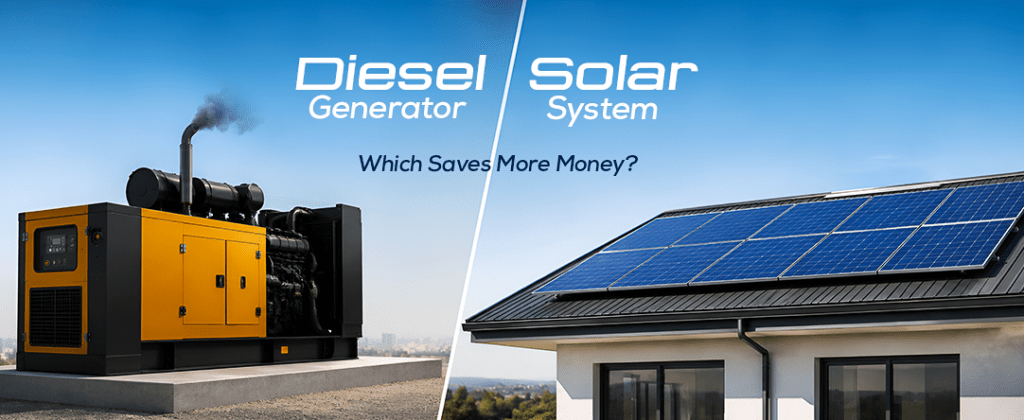
Diesel Generator vs Solar System in Pakistan: Which Actually Costs Less Over Five Years?
If you own a home, run a factory, or manage an office in Pakistan, you already know the frustration of relying solely on the grid. Between soaring peak-hour tariffs and unexpected load shedding, having an alternative power source stopped being a luxury years ago.
For decades the answer was simple: buy a diesel generator. It was affordable to purchase, easy to install, and it kept the lights on.
Today, hybrid solar systems paired with lithium battery storage have fundamentally changed that equation. The debate has shifted from “how do I keep the lights on?” to “which option will not drain my bank account over the next five to ten years?” So let us break down the actual numbers — capital cost, running cost, and long-term returns — for a diesel generator versus a hybrid solar system in Pakistan.
The Generator Wins This Round
Looking strictly at initial capital expenditure, diesel generators are the cheaper entry point.
A 10kVA to 15kVA diesel generator, complete with canopy and automatic transfer switch panel, typically costs between Rs. 650,000 and Rs. 1,200,000 depending on brand, silencing quality, and control gear. A complete 10kW hybrid solar system — Tier-1 panels, a hybrid inverter, mounting structure, and a lithium battery bank — generally lands between Rs. 1,600,000 and Rs. 2,200,000 depending on storage capacity and inverter class.
So a generator requires roughly half the upfront capital of a quality solar installation. This is where the financial illusion begins, because capital cost is the only metric on which the generator wins.
Running Costs Where the Entire Comparison Flips
A diesel generator is not a one-time purchase. It is an ongoing expense stream that you fund every single time there is an outage. A solar system is a one-time capital investment that produces energy for free, every day, for decades.
Consider the real arithmetic of running a 10 kVA diesel generator at a moderate load of about five to six kilowatts. Such a set consumes roughly 1.6 to 2.0 litres of diesel per hour under that load. With diesel in the range of Rs. 378 to Rs. 390 per litre in late 2026, that works out to approximately Rs. 605 to Rs. 756 per hour of operation.
Converted to the way you actually think about electricity, that is roughly Rs. 100 to Rs. 126 for every single unit the generator produces. Compare that with a grid tariff of Rs. 35 to Rs. 50 per unit, and you can immediately see why generator hours are the most expensive electricity any Pakistani household or business ever buys.
At three hours of daily load shedding, this becomes Rs. 54,000 to Rs. 68,000 per month, or between Rs. 650,000 and Rs. 816,000 per year, spent purely on fuel. In areas facing six hours of daily outages, that annual figure crosses Rs. 1.3 million. Add engine oil changes, filter replacements, injector servicing, battery replacements for the starting motor, and periodic top-end overhauls, and the total cost of ownership climbs further still. Permit a reasonable nine percent annual diesel price escalation and a generator running three hours a day accumulates roughly Rs. 3.9 million to Rs. 4.9 million in fuel alone across five years.
Now consider the running cost of a 10 kW hybrid solar system. Fuel cost is zero. Maintenance is limited to periodic washing of dust from the modules, occasional inspection of terminal connections, and an annual check of mounting hardware — realistically Rs. 5,000 to Rs. 10,000 per year. That is the entire operating expense.
Over five years, a 10 kVA generator with its capital cost, fuel, and maintenance represents approximately Rs. 4.8 million of outflow, rising to Rs. 8.7 million in a six-hour outage area. A 10 kW hybrid solar system costs its capital price plus roughly Rs. 50,000 of upkeep over the same period.
The Structural Difference Most Comparisons Miss
There is a fundamental asymmetry in how these two systems create value, and it decides the whole argument.
A generator only saves you money during outages. The moment grid power returns, the generator sits idle in the yard while you continue paying whatever the DISCO charges — including peak-hour rates that reach Rs. 47 to Rs. 60 per unit once taxes and fuel price adjustments are applied to higher slabs — and including fixed charges you cannot avoid even in a month with zero consumption.
A solar system works 365 days a year. It powers your loads directly from sunlight during daylight hours, reducing the units you import from the grid. It charges a lithium battery bank so evening consumption is served from stored solar rather than expensive peak-rate imports. And it exports surplus generation under the current net billing framework. Crucially, it also reduces your fixed charge exposure, because lower peak draw translates into a lower maximum demand indicator on commercial and industrial connections.
A generator is a cost-avoidance tool for outages only. Solar is a cost-reduction asset that operates every single day regardless of whether the grid is up or down.
The 2026 Net Billing Correction You Need to Know
Many solar vs generator comparisons still quote payback periods of two to three years based on one-for-one net metering. That framework no longer applies to new connections.
Under NEPRA’s Prosumer Regulations 2026, new distributed generation connections operate on net billing. Units you import from the grid are billed at your normal retail tariff, while units you export are credited at the national average energy purchase price — currently in the region of Rs. 10 to Rs. 13 per unit. Existing connections approved before February 2026 retain their original terms until those agreements expire.
This changes the payback arithmetic considerably, and it changes how you should size a system. An oversized array built to export heavily now earns very little for its surplus. A system sized to your actual daytime consumption, ideally paired with battery storage to shift noon generation into evening use, captures the full retail tariff on every unit it produces. That is where the real return lives.
On that basis, a well-sized 10 kW hybrid system with roughly 10 kWh of storage, generating about 1,200 to 1,300 units per month with 70 to 80 percent self-consumption, saves in the region of Rs. 40,000 to Rs. 45,000 per month — around Rs. 500,000 per year at current tariffs, before any annual tariff escalation. Against a capital cost of Rs. 1.6 million to Rs. 1.9 million, that is honest payback in the range of three to four years. Premium configurations with larger battery banks stretch toward four to four-and-a-half years.
Layered Architecture, Not Total Replacement
If your only requirement is emergency backup for a handful of hours per month, a small generator remains a sensible, low-capital tool. It is not the wrong purchase in that specific scenario.
But for homes, commercial offices, factories, and agricultural operations in Pakistan facing daily load shedding, solar is the financially superior asset by a very wide margin. The honest recommendation is not to throw the generator away, though. It is to build a layered architecture: grid supply as the primary source, rooftop solar with lithium storage as your working power plant, and a smaller generator retained purely as deep reserve for extended multi-day outages or prolonged monsoon cloud cover. Sized this way, your generator runtime collapses by seventy to ninety percent, and the fuel line on your operating budget all but disappears.
Over a five-year horizon, the difference between the two paths is in the region of Rs. 5.9 million in the majority of scenarios. Over ten years, accounting for one battery and inverter replacement reserve, the gap widens to well above Rs. 10 million. After capital recovery, solar continues producing for the remaining two decades of its rated life, while a generator continues consuming money every time you turn the key.
MaxPower Equipment for the Solar Side of This Decision
MaxPower builds the power electronics and storage that make this comparison work in practice, engineered for Pakistan’s ambient heat, dust loading, and unstable grid voltage.
On the inverter side, the MaxPower hybrid inverter range covers residential and commercial tiers. The Suntronic PV3000 and PV5000 Pro serve compact single-phase installations with wide DC input windows and pure sine wave output. The Suntronic PV6000 and PV7000 Pro add the surge overhead needed for multiple inverter air conditioners and compressor startup. The Voltas HYD single-phase and three-phase line, from HYD-6K-H6 upward, delivers dual MPPT tracking, generator integration terminals, and parallel clustering for larger premises. A technical comparison across these lines is available in the MaxPower inverter comparison guide.
For storage, the MaxPower LiFePO4 lithium battery lineup spans the MP-5000 Ultra at 5.12 kWh, the MP-10000 Ultra at 10.5 kWh, the MP-16000 Ultra at 16 kWh, and the MP-32000 Ultra at 32 kWh with 8,000 cycles at 80 percent depth of discharge. Every unit offers high usable depth of discharge, CAN and RS485 communication for inverter handshakes, zero electrolyte maintenance, and cycle life measured in thousands rather than hundreds. For three-phase commercial installations, the HP-5000-H high-voltage modular battery scales from 10.44 kWh per stack upward with IP65 or IP20 enclosure options.
Wiring, communication setup, and bank sizing are covered step by step in the inverter and lithium battery setup guide, while runtime arithmetic for your specific loads is set out in how to calculate battery backup hours.
Frequently Asked Questions
Is a diesel generator cheaper than solar in Pakistan?
Only on purchase price. A 10 kVA generator costs roughly half the upfront capital of a 10 kW hybrid solar system, but it then consumes Rs. 650,000 to Rs. 816,000 per year in diesel at three hours of daily use. Across five years, the generator’s total cost of ownership exceeds a solar system’s by roughly Rs. 5.9 million in typical scenarios.
What is the actual per-unit cost of generator electricity in Pakistan?
At current diesel prices of around Rs. 378 to Rs. 390 per litre, a 10 kVA set consuming 1.6 to 2.0 litres per hour at moderate load produces electricity at roughly Rs. 100 to Rs. 126 per unit. That is two to three times the grid tariff, which is why generator hours cost far more than most owners realise.
How long does a 10 kW hybrid solar system take to pay for itself in 2026?
Under the current net billing framework, three to four years for a system sized to daytime consumption with 70 to 80 percent self-consumption. Premium configurations with larger battery banks typically land between four and four-and-a-half years. Households that shift heavy appliance use into daylight hours shorten these periods further.
Can I remove my diesel generator completely after installing solar?
In most cases, no, and you should not try. A properly sized hybrid system with lithium storage eliminates the vast majority of generator runtime, but retaining a small generator as deep reserve for extended outages or prolonged overcast periods is the sensible engineering choice. The goal is reducing generator hours by seventy to ninety percent, not eliminating the machine.
Does net metering still make solar worthwhile in Pakistan?
Yes, but the economics have shifted. Under NEPRA’s Prosumer Regulations 2026, exported units earn the national average energy purchase price rather than the retail tariff. That means self-consumed solar is now far more valuable than exported solar, making daytime consumption patterns and battery storage the primary drivers of return.
Is solar still worth it compared to continuing with the grid and a generator?
For any household or business facing regular load shedding and high slab tariffs, yes. Solar displaces full retail tariff units every day of the year rather than only during outages, and it operates for twenty-five years against a generator that requires fuel every single hour it runs.