Solar Panel Price in Pakistan 2026: Complete Market Guide & Per-Watt Rates
July 22, 2026
Common Mistakes to Avoid When Installing a Solar Energy System in 2026 – Max Power Solar Solutions
October 3, 2026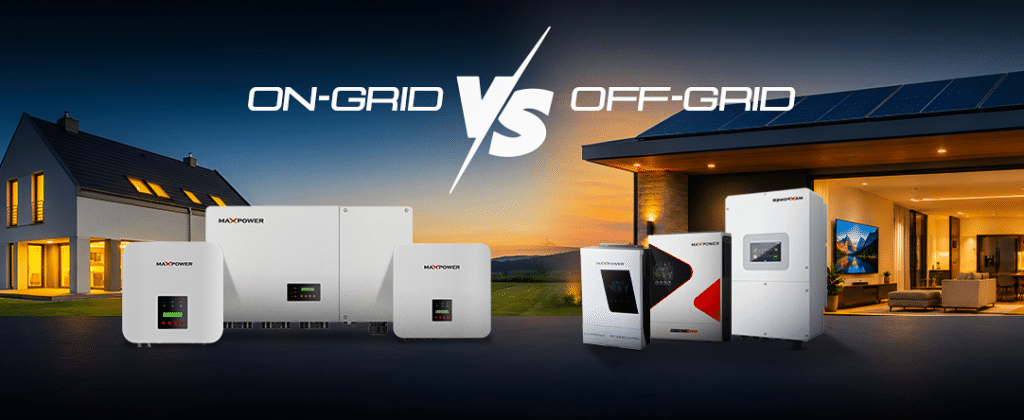
Electricity tariffs in Pakistan have been rising consistently, and power outages remain a daily challenge for millions of households and businesses. In this environment, switching to solar energy has become one of the smartest long-term investments for Pakistani homeowners and commercial users. However, before installing a system, every buyer faces the same critical question: should I choose an on-grid solar system or an off-grid solar system? Both configurations have their own strengths, limitations, and ideal use cases. In this complete 2026 guide, we compare both options in detail based on Pakistani market conditions, net metering policies, battery costs, and real-world energy needs so you can make an informed decision for your home or business.
What Is an On-Grid Solar System?
An on-grid solar system, also known as a grid-tied or net-metered system, is a solar setup that remains connected to the public electricity grid operated by WAPDA or your local utility provider. During the day, your solar panels generate DC electricity, which is then converted into usable AC power through a solar inverter. This electricity is immediately used to run your home appliances. If your panels produce more energy than your house is consuming at any given moment, the surplus power is automatically exported to the national grid. Your electricity meter records this export, and under Pakistan’s net metering policy, you receive a credit adjustment on your monthly utility bill. Because on-grid systems do not require battery storage, they are significantly cheaper to install and require almost no regular maintenance. However, the major limitation is that when the grid goes down due to load shedding or a power failure, the inverter automatically shuts off the solar supply as well. This is a mandatory safety feature designed to protect utility workers who may be repairing grid lines.
What Is an Off-Grid Solar System?
An off-grid solar system is a completely standalone power solution that operates independently from the utility grid. In this configuration, your solar panels charge a large bank of batteries during daylight hours, and that stored energy is used to power your property at night or during periods of low sunlight. Off-grid systems are the perfect choice for remote areas where WAPDA connections do not exist or for locations that suffer from prolonged and frequent load shedding. With a properly designed off-grid setup, you achieve complete energy independence, meaning zero electricity bills and no reliance on external grid infrastructure. That said, off-grid systems come with a much higher upfront cost because lithium battery banks are expensive. Additionally, batteries have a limited lifespan, typically ranging between five to ten years depending on the chemistry and usage, after which they must be replaced. System sizing is also more complex because you must accurately calculate your daily energy consumption, peak load demand, and the number of backup days required to avoid draining your batteries beyond safe limits.
Which System Is Better for Pakistan in 2026?
If you live in a major Pakistani city such as Karachi, Lahore, Islamabad, Rawalpindi, or Faisalabad where the utility grid is available and net metering is operational, an on-grid system is by far the most financially attractive option. The combination of lower installation costs and the ability to sell excess units back to the grid allows urban homeowners to recover their initial investment within three to five years. After the payback period, you essentially enjoy two decades of nearly free electricity. On the other hand, if you reside in a rural village, operate a farm, or run a commercial facility in an area with no grid access or daily power cuts lasting eight to twelve hours, an off-grid system becomes a necessity rather than a luxury. In 2026, lithium battery prices in Pakistan have declined slightly compared to previous years, making off-grid setups more accessible than before, but they still remain more expensive than grid-tied alternatives. For buyers who want the best of both worlds, hybrid solar systems combine grid connectivity with battery backup, though they sit at the highest end of the pricing spectrum.
Cost Comparison: On-Grid vs Off-Grid in Pakistan
A typical 5kW on-grid solar system in Pakistan costs approximately PKR 550,000 to PKR 650,000 including Tier 1 panels, a branded inverter, mounting structure, and professional installation. This setup can generate around twenty to twenty-five units per day, which is sufficient for an average Pakistani household. In contrast, a 5kW off-grid system with a quality lithium battery bank can cost anywhere from PKR 800,000 to PKR 1,000,000 because the battery component alone adds three to four hundred thousand rupees to the total price. If you opt for cheaper lead-acid batteries, the initial cost drops, but you will face higher maintenance requirements and a shorter battery life of only three to four years. When you calculate the total cost of ownership over a ten-year period, on-grid systems deliver superior savings for grid-connected users because there are no battery replacement expenses. Off-grid buyers must factor in the hidden cost of battery replacement every seven to eight years when evaluating their return on investment.
Advantages of On-Grid Solar Systems
The biggest advantage of an on-grid system is its affordability. Because there are no batteries involved, the upfront investment is lower, making solar accessible to middle-income families across Pakistan. Net metering allows you to monetize your surplus electricity by exporting extra units to the grid, which dramatically reduces or in some cases completely eliminates your monthly electricity bill. Maintenance is minimal since modern string inverters and monocrystalline panels are designed to last twenty to twenty-five years with only occasional cleaning. The grid essentially acts as a virtual battery, storing your excess energy for free and ensuring that no generated unit goes to waste. For urban homes that remain empty during daytime working hours, on-grid solar is the most logical and profitable investment you can make in 2026.
Disadvantages of On-Grid Solar Systems
The most significant drawback of an on-grid configuration is that it cannot function during a grid outage. Even if the sun is shining brightly and your panels are producing full capacity, your inverter will stop supplying power to your home the moment the grid fails. This means on-grid solar does not protect you from load shedding. Additionally, the net metering approval process in some Pakistani districts can still be slow and involves paperwork with your local utility provider. Areas with poor grid infrastructure, voltage fluctuations, or frequent transformer failures may also stress your inverter over time. Finally, if you live in a location with no existing WAPDA connection, an on-grid system is simply not an option.
Advantages of Off-Grid Solar Systems
Off-grid solar delivers complete energy autonomy. You are fully protected from grid failures, tariff hikes, and infrastructure breakdowns because your home operates on its own independent power plant. As long as your system is correctly sized by a professional solar consultant, you can enjoy twenty-four-hour electricity without ever paying a utility bill. This makes off-grid systems ideal for northern areas, agricultural lands, remote construction sites, and villages where extending grid lines is either too expensive or technically impossible. In recent years, Pakistan has experienced devastating floods and natural disasters that crippled the national grid for weeks. Off-grid users remained powered during those crises, proving the resilience of standalone solar systems. You also gain full control over your energy usage and are never subject to unpredictable electricity price increases from the utility.
Disadvantages of Off-Grid Solar Systems
The primary barrier for off-grid adoption is the high initial investment, which runs forty to fifty percent higher than an equivalent on-grid setup. Battery banks are not only expensive to purchase but also come with a finite lifespan, meaning replacement is inevitable. Designing an off-grid system requires careful load analysis because if you underestimate your consumption, your batteries may run dry during cloudy stretches or rainy seasons. In some cases, users must keep a backup generator for extended periods of bad weather, which adds fuel and maintenance costs. Off-grid systems also demand more installation space since you need a secure, ventilated area for the battery cabinet in addition to the roof space for panels.
Which System Suits Which Location?
If you are an urban homeowner with a reliable grid connection and daily load shedding does not exceed two to three hours, an on-grid solar system is the best choice for you. It offers the fastest payback, lowest maintenance, and maximum utilization of net metering credits. If you live in a rural area, own a farmhouse, or operate a business that requires uninterrupted power such as a clinic, cold storage, or dairy farm, then an off-grid solar system or a hybrid solar system is the safer investment. For commercial buildings, schools, hospitals, and factories that need both bill reduction and backup power, hybrid systems are increasingly popular because they combine net metering with emergency battery support. In 2026, the dominant trend in Pakistan is that on-grid systems are leading in cities while off-grid and hybrid configurations are expanding rapidly in rural and commercial applications.
Key Factors to Consider Before Installation
Before you decide between on-grid and off-grid, confirm whether net metering is available in your specific area and whether your local utility supports bidirectional metering. Review your past twelve months of electricity bills to understand your average monthly consumption in units. Inspect your roof space, direction, and shading; a south-facing roof without heavy shadow from nearby buildings or trees is ideal for maximum solar output. Always insist on Tier 1 solar panels and A-grade inverters from reputable manufacturers because substandard equipment can reduce system efficiency and void warranties. If you are leaning toward off-grid, choose lithium iron phosphate batteries over lead-acid because they are safer, longer-lasting, and more efficient in Pakistan’s temperature conditions. Finally, verify your installer’s certification, past projects, and after-sales support because poor installation can ruin even the best equipment.
Conclusion
Both on-grid and off-grid solar systems are excellent technologies, but they serve different needs. In the context of Pakistan in 2026, on-grid solar is the clear winner for the majority of urban, grid-connected households due to its lower upfront cost, net metering benefits, and absence of battery maintenance. Off-grid solar remains the essential solution for remote areas and users who demand total independence from the utility infrastructure. Your final decision should be based on your location, budget, backup requirements, and daily energy consumption pattern. Regardless of which path you choose, solar energy is no longer an experimental technology in Pakistan; it is a proven, profitable, and necessary upgrade for every property owner tired of rising electricity bills.
Frequently Asked Questions
Does an on-grid solar system work during load shedding?
No. An on-grid system automatically shuts down during a grid outage as a safety measure to prevent back-feeding electricity into the grid and endangering utility workers.
What is the price of a 5kW solar system in Pakistan in 2026?
A 5kW on-grid system typically costs between PKR 550,000 and PKR 650,000, while a 5kW off-grid system with lithium batteries ranges from PKR 800,000 to PKR 1,000,000 depending on battery capacity and brand.
Is net metering available in every Pakistani city?
Net metering is currently available in most major cities including Karachi, Lahore, Islamabad, Rawalpindi, Faisalabad, and Multan. However, some smaller towns and rural regions are still in the process of full implementation.
How long do batteries last in an off-grid system?
Quality lithium batteries generally last between seven to ten years. Lead-acid batteries, on the other hand, usually require replacement every three to four years under normal Pakistani usage conditions.
Do solar panels generate electricity during the rain?
Solar panels rely on sunlight, so their output drops significantly during heavy cloud cover or rain. However, they still produce some power in diffused light. For off-grid users, this is why adequate battery storage is essential.
Can I add batteries to an on-grid system later?
Only if your inverter is a hybrid model designed to accept battery connections in the future. Standard on-grid inverters do not support battery integration, so it is wise to plan for future expansion at the time of initial purchase.
Can I run air conditioners on solar power?
Yes. A properly sized solar system can easily run inverter air conditioners along with refrigerators, water pumps, and other heavy appliances. Residential systems in the 5kW to 10kW range are commonly configured to handle AC loads in Pakistan.