PV Tech Inverter Review: Features, Performance & Is It Worth It for Pakistani Homes?
August 3, 2026
PV Tech Hybrid Inverters vs Traditional UPS: A Full Comparison for Pakistani Homes
August 7, 2026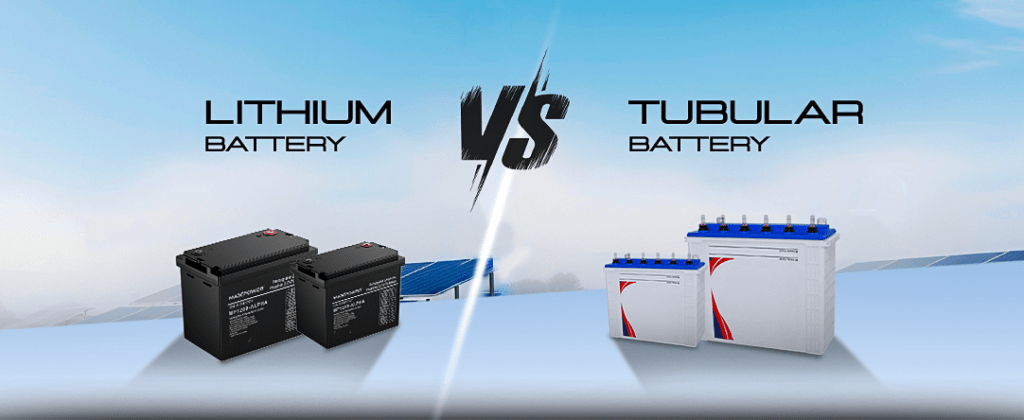
This comparison gets simplified unfairly in most solar conversations in Pakistan. The tubular battery is presented as the budget choice and the lithium battery as the expensive upgrade, and the conversation ends there. The real question, which battery costs less over 10 years of daily cycling, rarely gets answered with actual numbers.
Let us answer it now, with verified Pakistani market figures and a straightforward comparison.
What a Tubular Battery Actually Costs Over 10 Years
The Sticker Price Is Not the Total Price
A quality tubular battery in Pakistan in 2026, from brands like Phoenix, Osaka, or AGS in the 200Ah range, costs between PKR 55,000 and PKR 85,000 per unit. For a medium Pakistani home needing reasonable backup through daily load shedding, a typical setup uses 2 to 4 batteries in series or parallel.
Using PKR 70,000 per battery and 2 batteries for a mid-range setup: PKR 140,000 for the initial bank.
Tubular batteries under daily cycling conditions last approximately 1,200 cycles, or 3 to 5 years, under good maintenance conditions. Under Pakistan’s reality of daily deep cycling, summer heat, and inconsistent maintenance, 2 to 3 years is the more common outcome.
Over 10 years, that bank is replaced 3 to 4 times.
- 4 replacements × PKR 140,000 = PKR 560,000 in battery cost alone
Add water top-up costs, terminal cleaning, and the occasional battery failure before the end of its natural life, and the realistic 10-year cost of a tubular battery bank is PKR 600,000 to PKR 700,000.
There is also the efficiency penalty. A tubular battery can only be discharged to 50% without damaging its health, while a lithium battery can be safely discharged to 90% to 95%. A 200Ah tubular bank at 50% usable depth provides 100Ah of real backup. The same rated capacity in lithium at 90% usable depth provides 180Ah. You are getting nearly twice the usable backup per rupee of rated capacity from lithium.
What a Lithium Battery Actually Costs Over 10 Years
One Purchase That Covers the Decade
The Max Power MP-10000 Alpha at 10 kWh provides more usable backup energy than most two-unit tubular battery banks. It is rated for 8,000 life cycles, which is over 21 years at one cycle per day. Under Pakistani real-world conditions, expect 12 to 15 years of service before noticeable capacity reduction.
Approximate price for the MP-10000 Alpha: contact Max Power for current pricing. For comparison context, Max Power’s battery pricing is structured to reflect LiFePO4 cell quality, BMS engineering, and warranty depth.
The 10-year cost is the purchase price. No replacements. No maintenance. No water. No terminal treatment. No distilled water purchases.
The lithium battery also recovers more energy from your solar panels per day due to its higher round-trip efficiency of 95% to 98% versus tubular’s 75% to 80%. For a system generating 20 units per day, lithium stores and returns 19 to 19.6 units. Tubular stores and returns 15 to 16 units. The difference is 3 to 4 units per day in recovered solar energy, which at PKR 60 per unit translates to PKR 180 to PKR 240 per day, or PKR 65,700 to PKR 87,600 per year in additional electricity savings.
The 10-Year Comparison
• Initial Investment
Tubular Battery Bank → Around PKR 140,000 upfront
MP 10000 Alpha Lithium → Higher upfront cost but designed for long-term value
• Battery Replacements Over 10 Years
Tubular Battery Bank → Typically requires replacement 3 to 4 times
MP 10000 Alpha Lithium → Single purchase with no repeated replacement cycle
• Total Purchase Cost Across 10 Years
Tubular Battery Bank → PKR 560,000+ over time
MP 10000 Alpha Lithium → One-time investment approach
• Usable Backup From Every 100Ah Rated Capacity
Tubular Battery Bank → Around 50Ah usable output
MP 10000 Alpha Lithium → Around 80 to 90Ah usable output
• Round Trip Efficiency
Tubular Battery Bank → Approximately 75% to 80%
MP 10000 Alpha Lithium → Approximately 95% to 98%
• Maintenance Requirements
Tubular Battery Bank → Regular water top-up and terminal cleaning
MP 10000 Alpha Lithium → Zero routine maintenance
• Warranty Coverage
Tubular Battery Bank → Usually 1 to 2 years
MP 10000 Alpha Lithium → 5-year Max Power warranty
The tubular battery costs less at the point of purchase. The lithium battery costs less across the decade of ownership. The crossover point, where lithium’s total cost of ownership becomes lower than tubular’s cumulative replacement cost, typically occurs between years 3 and 5 in Pakistan’s daily cycling environment.
When Tubular Still Makes Sense in Pakistan
Tubular batteries remain a valid choice in two specific situations. First, when the upfront cost is genuinely prohibitive and budget constraints make lithium impossible in the short term. A quality tubular battery in year one with a clear plan to upgrade to lithium at the first replacement cycle is a sensible staged approach. Second, for systems in locations where lithium-certified installation is not available and the risk of incorrect inverter settings is higher than average.
For every other Pakistani solar buyer, the 10-year economics of lithium are straightforward. The money spent on tubular replacements and the energy lost to lower efficiency is money that a lithium battery investment eliminates.
Frequently Asked Questions
Is a lithium battery worth the higher upfront cost compared to a tubular one in Pakistan?
Yes, when you account for the full 10-year cost of ownership. A tubular battery bank replaced 3 to 4 times over a decade costs more in total than a single lithium battery that serves the same period. The lithium battery also provides more usable backup energy per rated kWh and higher round-trip efficiency from your solar panels.
How many years does a tubular battery last with daily load shedding in Pakistan?
Under Pakistan’s daily cycling conditions with summer heat, tubular batteries typically last two to three years. Quality brands with good maintenance may extend this to 3 to 4 years, but daily deep cycling in high temperatures shortens the practical lifespan compared to manufacturer claims made under standard test conditions.
Can I replace my existing tubular batteries with Max Power lithium batteries?
Yes, if your inverter supports lithium battery chemistry. Most hybrid inverters from 2021 onward have a lithium battery mode. The inverter charge profile must be updated when switching from tubular to lithium. Max Power’s team can confirm compatibility and correct settings for your specific inverter model.
Does a lithium battery deliver more backup hours than a tubular battery of the same rated capacity?
Yes, significantly. A 200Ah lithium battery at 90% usable depth provides 180Ah of real backup. A 200Ah tubular battery at 50% usable depth provides 100Ah. The lithium battery delivers approximately 80% more usable backup from the same nominal rating, which translates directly to longer coverage during load shedding at the same load.
What is the maintenance difference between lithium and tubular batteries in Pakistan?
Tubular batteries require regular distilled water top-up (every 1 to 3 months depending on usage), periodic terminal cleaning, equalization charging, and careful monitoring of electrolyte levels. Neglect of any of these shortens lifespan. Lithium batteries require zero chemical maintenance. The only recommended maintenance is an annual connection check and monitoring inverter settings for continued correct configuration.
Have You Actually Calculated What Your Tubular Batteries Will Cost You Over the Next Decade?
The upfront price comparison between tubular and lithium does not tell you which battery is cheaper. The 10-year total cost comparison does. For most Pakistani homeowners cycling batteries daily through load shedding, that calculation consistently points toward lithium.
Explore Max Power’s lithium battery range and reach out to our team to discuss the right replacement capacity for your current backup setup.