Best Hybrid Inverter in Pakistan: A Buyer’s Guide to Max Power’s Voltas Series
August 17, 2026
Lithium vs Tubular Batteries: Which One Actually Saves More Money in Pakistan?
July 29, 2026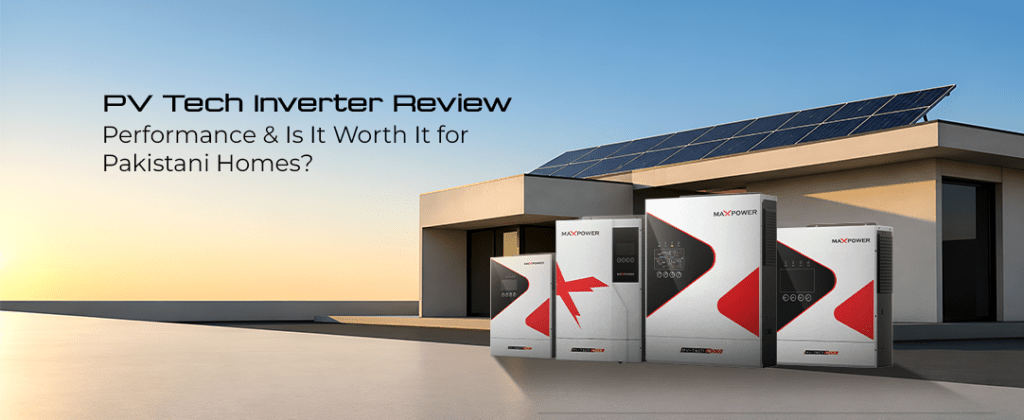
Pakistan’s solar inverter market in 2026 has more options than ever, and the PV Tech series from Max Power has carved out a clear position in the residential and light commercial segment. This review covers the PV Tech lineup’s specifications, real-world performance considerations, and who these inverters are actually suited for in Pakistan’s load-shedding and grid environment.
This is not a promotional description. It is an honest technical look at what the PV Tech series delivers and where it fits versus other options in Max Power’s lineup.
What the PV Tech Series Is and Who It Is For
The PV Tech series sits in Max Power’s inverter lineup as the hybrid solar inverter range designed specifically for residential and small commercial applications in Pakistan. It combines solar charging, battery management, and grid backup in a single unit designed for the price point and feature set that most Pakistani homeowners need without paying for commercial-grade features they will not use.
The PV Tech range is IP21 rated, which means it is designed for enclosed indoor installation in a clean, protected utility room or interior wall-mounted position. If your installation is outdoor or semi-exposed, the Voltas H6 series with IP66 protection is the appropriate alternative within Max Power’s lineup.
Core Technical Specifications That Matter
MPPT Solar Charging
The PV Tech series features a built-in MPPT solar charge controller with a working voltage range of 60V to 450V and a maximum DC input voltage of 500V. This accommodates standard residential panel string configurations comfortably, including 4 to 8 panel strings using 550W to 600W monocrystalline panels at typical Pakistani string voltages.
The maximum solar charge current varies by model within the PV Tech range. Confirm the charge current rating for your specific model against your panel array’s maximum string current to ensure the combination is within spec.
Battery Compatibility
The PV Tech series supports both lead-acid and lithium-ion battery chemistries. For lithium-ion use, the inverter must be set to the appropriate LiFePO4 charge profile. The BMS communication port supports active communication with compatible lithium batteries, including Max Power’s MP series, enabling intelligent charge management based on real-time battery state rather than voltage estimates.
Transfer Time and Load Protection
The PV Tech series achieves a transfer time of 10ms for computer and UPS-sensitive loads and 20ms for general appliance loads. This is fast enough to keep computers, routers, and modern televisions running through grid-to-battery transitions without interruption. The 10ms figure is what separates hybrid inverters from basic UPS units and is the specification that determines whether your home electronics experience a load shedding event or sail through it unnoticed.
Working Modes
The PV Tech series supports multiple intelligent working modes:
- Solar priority: uses solar first, then grid; battery charges from solar only
- Grid priority: uses grid first for loads, solar charges battery
- Battery mode: runs from battery, charges from solar when available
- Grid charging: allows grid to charge battery during off-peak hours
These modes give Pakistani homeowners genuine flexibility in managing their energy source priority based on current tariff structures and grid availability patterns.
Performance in Pakistan’s Grid Conditions
Wide Voltage Input Tolerance
Pakistan’s grid voltage in many areas fluctuates significantly outside standard tolerances. The PV Tech series handles an AC input voltage range of 90V to 280V, which accommodates the voltage instability common in Pakistani distribution networks without triggering false grid-failure switching events. This is a meaningful specification for areas where voltage fluctuation is routine.
Operating Temperature Range
The PV Tech series is rated for operation from 0°C to 55°C. This covers Pakistan’s full ambient temperature range, including summer peak temperatures in Punjab and Sindh, where outdoor temperatures exceed 45°C, though the inverter should be installed in a ventilated indoor space rather than directly in that peak outdoor ambient.
PV Tech vs Voltas: When to Choose Which
Within Max Power’s lineup, the choice between PV Tech and Voltas H4/H6 comes down to installation environment and feature requirements.
Choose PV Tech when:
- Installation is in a clean, enclosed indoor room (IP21 is sufficient)
- Budget is a primary consideration
- Your panel layout is straightforward single-orientation
- You do not need four MPPT trackers
Choose Voltas H4 or H6 when:
- Installation is outdoor, on an exterior wall, or semi-exposed (IP66 required)
- You need a 7-inch colour touch LCD interface
- You need a diesel generator input for areas without reliable grid
- You need four independent MPPT trackers for complex multi-orientation panel layouts
Both series support the same battery types and are compatible with Max Power’s MP series lithium batteries. Browse the full PV Tech range and the Voltas range at Max Power’s product pages.
Is the PV tech worth it?
For Pakistani homeowners installing in an indoor location who want a quality hybrid inverter at a competitive price with BMS-connected lithium battery support, a wide AC input voltage range, and a 10 ms transfer time, yes. The PV Tech series delivers the specifications that matter for load-shedding backup at a price point accessible to the mainstream Pakistani residential market.
For buyers who need outdoor installation capability, four MPPT trackers, or a larger LCD interface for daily monitoring, the Voltas H6 is the more complete product and justifies its higher price.
Frequently Asked Questions
What is the PV Tech inverter series from Max Power?
The PV Tech series is Max Power’s residential and light commercial hybrid solar inverter range, combining solar MPPT charging, battery management, and grid backup in a single unit. It is IP21 rated for indoor installation and supports both lead-acid and lithium-ion battery chemistries with BMS communication.
What is the transfer time of the PV Tech inverter during load shedding?
The PV Tech series achieves 10ms transfer time for sensitive computer and UPS loads and 20ms for general appliance loads. This is fast enough to prevent computers, routers, and modern televisions from shutting down during grid-to-battery transitions.
Can the PV Tech inverter be installed outdoors in Pakistan?
No. The PV Tech series carries an IP21 protection rating, which is designed for clean, enclosed indoor installation. For outdoor wall mounting or semi-exposed locations, Max Power’s Voltas H6 series with IP66 protection is the correct specification.
Where can I buy the PV Tech inverter in Pakistan?
The PV Tech series is available through Max Power’s authorized dealer network across Lahore, Karachi, Islamabad, and major cities nationwide. Browse the full range at Max Power’s PV Tech page or contact the team for current pricing and dealer locations.
Is the PV Tech the Right Inverter for Your Home’s Solar Setup?
If your installation is indoor, your panel layout is straightforward, and you want a feature-complete hybrid inverter at a competitive price point, the PV Tech series is a solid choice for Pakistani residential use. If your requirements go beyond these parameters, Max Power’s Voltas series is worth the additional investment.
Request a free estimate with us to confirm the price of your preferred model for your specific system.