Max Power Solar Inverters: A Reliable Choice for Solar Energy Systems
March 28, 2023
MaxPower’s Solar Pump Controller: An Introduction to the Latest Technology
March 25, 2023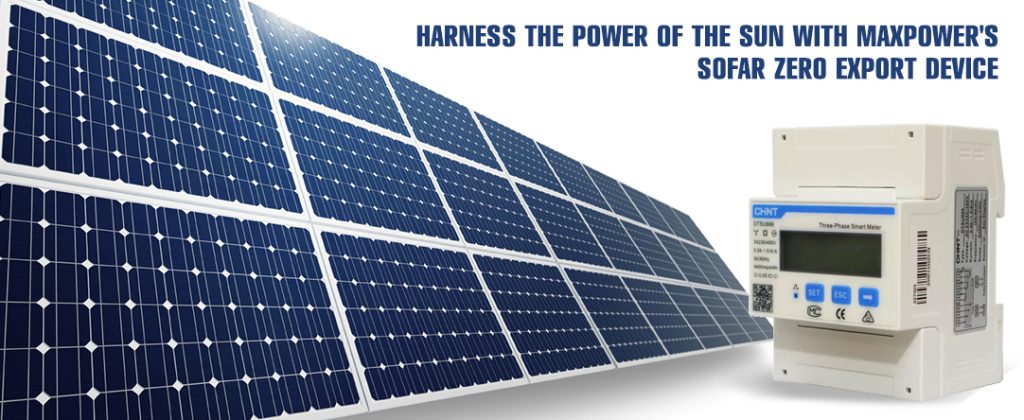
Pakistan’s solar energy market is rapidly evolving as homeowners and businesses look for ways to reduce electricity bills, improve solar self-consumption, and become less dependent on the conventional power grid.
One important challenge for grid-connected solar systems is controlling excess solar power that may otherwise be exported to the grid. This is where a zero export device can become an important part of a modern solar energy management system.
Max Power provides solar solutions for residential, commercial, and industrial applications in Pakistan, including solar inverters, lithium batteries, solar panels, and energy-storage solutions. Its current product portfolio includes SOFAR on-grid inverter solutions alongside hybrid inverters, lithium-ion batteries, and solar panels.
This guide explains what a SOFAR Zero Export Device does, how zero-export solar systems work, their benefits, and what Pakistani solar users should consider before installation.
What Is a Zero Export Device?
A zero export device is a solar energy management component designed to prevent or limit unwanted electricity from being exported from a solar system to the utility grid.
In a conventional grid-connected solar system, solar panels may generate more electricity than a property is consuming at a particular moment. Depending on the system configuration and applicable utility arrangements, that surplus may flow toward the grid.
A zero-export setup monitors electricity flow and helps regulate solar inverter output so that solar generation is matched more closely with the property’s real-time electricity consumption.
In simple terms:
Solar Generation → Home/Business Loads → Excess Generation Controlled
The objective is to maximize solar self-consumption while limiting or preventing power export to the grid.
Why Is Zero Export Important for Solar Systems in Pakistan?
Electricity consumption in Pakistan can vary significantly throughout the day.
For example, a home may generate 6 kW of solar power at midday while consuming only 2 kW. Without an appropriate export-control configuration, the remaining generation may potentially flow toward the grid.
A zero-export system can respond to changing consumption by controlling the inverter’s output.
This can be particularly useful for users who want to:
- Maximize on-site solar consumption
- Limit electricity export to the grid
- Manage solar generation according to real-time demand
- Reduce dependence on grid electricity
- Improve control over solar energy production
- Design solar systems around self-consumption rather than export
However, whether zero export is appropriate depends on the inverter, meter arrangement, utility requirements, and overall solar-system design.
How Does a SOFAR Zero Export System Work?
A zero-export setup generally relies on real-time measurement of power flowing between the solar installation, building loads, and grid connection.
The monitoring component measures electricity flow and communicates the required information to the inverter or energy-management system.
The basic operating process is:
1. Solar Panels Generate Electricity
Solar panels convert sunlight into DC electricity.
The solar inverter then converts this electricity into usable AC power for household, commercial, or industrial loads.
If you are comparing different panel technologies for a new installation, you can explore Max Power’s solar panels in Pakistan range for current available options.
2. The System Measures Electricity Consumption
A compatible monitoring device or meter measures how much electricity the property is consuming.
For example:
Solar generation = 8 kW
Property consumption = 5 kW
The system identifies that approximately 3 kW of generation is above the current on-site requirement.
3. The Inverter Adjusts Solar Output
Depending on the compatible SOFAR inverter and system configuration, the control system can regulate inverter output to reduce unwanted export.
The objective is to keep solar generation aligned with the property’s real-time consumption.
Max Power currently lists several SOFAR three-phase on-grid inverter models, including the SOFAR 15–24KTLX-G3, 25–50KTLX-G3, 60–80KTLX, and 125KTLX-G4 ranges.
4. Solar Power Is Prioritized for On-Site Loads
Instead of intentionally generating more AC power than the property requires, the system works toward maximizing the solar energy that is actually being consumed on-site.
This makes zero export particularly relevant for self-consumption solar systems.
What Does Zero Export Mean in Solar?
Zero export means limiting the flow of surplus solar electricity from the property back to the utility grid.
It does not automatically mean that the solar system becomes completely independent from the grid.
The exact behavior depends on whether the system is:
- On-grid
- Hybrid
- Battery-backed
- Grid-connected with export control
- Configured according to local utility requirements
Therefore, a zero-export system should be designed according to the specific inverter, electrical connection, battery configuration, and applicable regulations.
Key Benefits of a Zero Export Solar System
1. Better Solar Self-Consumption
A zero-export configuration helps focus solar generation on the property’s own electricity requirements.
This can improve the practical value of a solar installation for users who primarily want to reduce their grid electricity consumption.
2. Better Control Over Solar Generation
Real-time power monitoring allows the system to respond to changes in electricity demand.
For example, if a factory’s load falls suddenly, export-control settings can help reduce solar output relative to the site’s consumption.
3. Reduced Unwanted Grid Export
For installations where unrestricted export is not desired or permitted, a properly configured zero-export system can help limit electricity flowing toward the grid.
4. Useful for Commercial and Industrial Solar
Commercial buildings, factories, offices, and warehouses can have rapidly changing electricity loads.
Zero-export technology can be useful where the business wants to consume solar power on-site while maintaining control over grid interaction.
For larger projects, Max Power offers commercial and industrial solar inverter solutions across multiple capacities and configurations.
5. Real-Time Energy Monitoring
A properly designed system can provide visibility into:
- Solar generation
- Building consumption
- Grid import
- Grid export
- Inverter performance
- Energy-flow patterns
This information can help identify unusual consumption and improve energy-management decisions.
Zero Export vs. Net Metering
Zero export and net metering are not the same thing.
Net metering/export-enabled systems are designed to allow surplus electricity to flow to the grid under an applicable utility arrangement.
Zero-export systems are designed to limit or prevent that export.
The right approach depends on the property’s objectives, inverter capabilities, meter configuration, battery storage, and current utility rules.
If your primary goal is to maximize self-consumption and avoid exporting electricity, zero export may be worth considering.
If your solar investment is designed around exporting surplus electricity, the system should instead be configured for the applicable grid-interconnection arrangement.
For homeowners considering a complete grid-connected or hybrid setup, Max Power’s complete solar product range includes solar panels, hybrid inverters, on-grid inverters, and lithium battery storage.
Is a Zero Export Device the Same as a Solar Inverter?
No.
A solar inverter converts electricity generated by solar panels from DC to AC and manages the electrical output of the solar array.
A zero-export device or power-control system is primarily concerned with monitoring and controlling electricity flow so that solar generation does not exceed the configured export limit.
Some modern solar inverters can provide built-in export-control or load-monitoring functionality, meaning a separate external device may not always be required.
This is why the exact inverter model and system architecture should be checked before purchasing a separate zero-export device.
You can compare available solar inverters in Pakistan from Max Power to identify suitable on-grid and hybrid configurations.
Can Zero Export Work With a Battery Storage System?
Yes, depending on the inverter and system configuration.
A hybrid solar system can use batteries to store surplus solar energy instead of exporting it.
For example:
Solar generation = 8 kW
Home load = 5 kW
Surplus = 3 kW
Instead of exporting that 3 kW to the grid, a compatible hybrid system may direct surplus energy toward battery charging.
Later, the stored energy can be used when:
- Solar production falls
- Electricity demand increases
- The grid is unavailable
- Evening electricity consumption begins
This makes solar batteries and zero-export control complementary technologies in certain hybrid solar installations.
For homes and businesses that need energy storage, Max Power offers a range of lithium-ion batteries in Pakistan, including MP-series battery systems in different capacities.
Who Should Consider a Zero Export Solar System?
A zero-export configuration may be worth considering for:
- Homeowners focused on solar self-consumption
- Commercial buildings with significant daytime loads
- Factories and industrial facilities
- Businesses that want greater control over grid interaction
- Properties where unrestricted solar export is not desired
- Solar installations using compatible inverter and monitoring technology
The best solution depends on the site’s load profile and electrical infrastructure.
Is Zero Export Suitable for Homes in Pakistan?
Yes, zero-export technology can be suitable for residential solar systems in Pakistan when the inverter, monitoring equipment, and electrical configuration support it.
A typical example is a home with:
Solar system: 10 kW
Midday household load: 3–4 kW
Solar generation at peak: 8–9 kW
The system may produce substantially more power than the house is consuming at certain times.
A properly designed zero-export configuration can help control the inverter’s output according to the home’s electricity demand.
For homeowners, the main advantage is better control over solar self-consumption and grid interaction.
If battery backup is also required, a hybrid inverter and lithium battery can be considered as part of the overall solar system design.
Zero Export for Commercial Solar Systems
Commercial and industrial sites can benefit significantly from intelligent solar power management because their loads can change throughout the working day.
Consider a factory with:
- 100 kW solar installation
- 70 kW average daytime load
- Variable production schedules
If factory demand suddenly falls, solar production may exceed on-site consumption.
An appropriate export-control strategy can help keep generation aligned with the facility’s real-time electricity demand.
For larger systems, proper engineering, protection, CT/meter placement, inverter compatibility, and utility requirements become especially important.
Max Power’s current product range includes SOFAR three-phase on-grid inverter options from smaller commercial capacities through larger systems such as the 60–80KTLX and 125KTLX-G4.
Important Things to Check Before Installing Zero Export
Not every zero-export device works with every inverter.
Before installation, check the following:
Inverter Compatibility
Confirm that the device or meter is compatible with the exact inverter model.
CT or Meter Installation
The current transformer (CT) or energy meter must be installed and configured correctly so that the system accurately measures electricity flow.
System Configuration
Incorrect export-control settings can cause poor performance or unexpected inverter behavior.
Electrical Load
The installer should understand the property’s normal and peak electricity consumption.
Battery Compatibility
If batteries are part of the system, confirm that the inverter, battery and energy-management system can work together correctly.
Utility Requirements
Local grid-interconnection and electricity regulations can change. Always confirm the current requirements applicable to your connection before making a system decision.
Professional Installation
Zero-export control is part of the electrical architecture of a solar system. It should be installed and commissioned by qualified professionals rather than treated as a simple plug-and-play accessory.
How Max Power Can Help With Solar Energy Management in Pakistan
Max Power offers a broad portfolio of solar technologies for residential, commercial, and industrial applications, including:
- Solar panels
- Hybrid solar inverters
- On-grid solar inverters
- Lithium-ion battery storage
- Solar energy management solutions
- Solar pumping systems
- Installation and technical support
You can explore the Max Power solar products to compare current inverter, battery, and solar-panel solutions.
For customers specifically interested in SOFAR, Max Power currently lists a dedicated SOFAR solar inverter range with three-phase on-grid models for different project sizes.
For energy-storage requirements, you can also explore Max Power’s lithium-ion battery range, which includes multiple battery capacities for residential and commercial applications.
SOFAR Zero Export Device: Is It Worth It?
A zero-export solution can be valuable when the main objective is to control solar export and maximize on-site solar consumption.
However, it should not be selected solely because it is marketed as a zero-export device.
The correct solution depends on:
- Solar system size
- Inverter model
- Household or business load
- Battery storage
- Grid connection
- Export requirements
- CT/meter configuration
- Local utility rules
A professional site assessment can determine whether a dedicated zero-export device is necessary or whether the selected inverter already provides the required functionality.
Frequently Asked Questions
What is a zero export device in a solar system?
A zero-export device monitors electricity flowing between a property, solar inverter, and grid connection and helps control solar generation so that surplus electricity is not intentionally exported to the grid. The exact operation depends on the compatible inverter and system configuration.
Can I install a zero export device with my existing solar inverter?
It depends on your inverter model. Some solar inverters support external energy meters or zero-export control, while newer models may have export-control functionality built in. Compatibility should be confirmed using the inverter manufacturer’s specifications before installation.
Does zero export reduce solar panel efficiency?
No. Zero export does not reduce the efficiency of the solar panels themselves. Instead, the inverter may reduce its electrical output when solar generation is higher than the property’s permitted or required consumption. As a result, some available solar energy may not be generated or used when there is insufficient on-site demand or battery capacity.
Is zero export better than net metering in Pakistan?
Neither is universally better. Net-metering/export arrangements are designed around sending surplus electricity to the grid under applicable rules, while zero export focuses on limiting grid export and maximizing on-site consumption. The better option depends on electricity usage, system design, utility arrangements, and current regulations.
Can zero export work with lithium batteries?
Yes, when the inverter and energy-management system support battery integration. In a compatible hybrid system, surplus solar energy can potentially charge the lithium battery instead of being exported. The stored energy can then be used later when solar production is lower or the grid is unavailable.