Best Solar Panel and Inverter Prices in Pakistan 2026 Guide
July 28, 2026
How Factories Can Reduce Electricity Bills by 70% with MaxPower Solar Energy Solutions
August 26, 2026Commercial Solar Backup in Pakistan Unlocking Energy Independence and High ROI with MaxPower
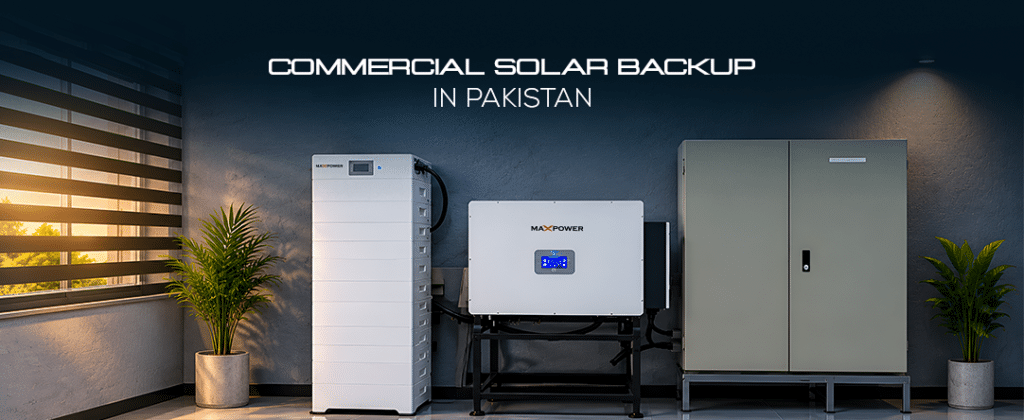
High commercial electricity tariffs, aggressive Maximum Demand Indicator (MDI) charges, and persistent grid load shedding represent three of the heaviest operational risks for businesses across Pakistan today. Whether you manage a software house in Lahore, a textile processing unit in Faisalabad, a private surgical hospital in Karachi, or a retail plaza in Islamabad, uninterrupted electrical power is directly tied to your bottom line. An unexpected feeder trip does not merely turn off lights; it halts computerized production lines, corrupts server data, idles expensive staff, and damages sensitive diagnostic and industrial machinery.
For decades, commercial enterprises relied on heavy-duty diesel generators to bridge grid failures. However, soaring diesel prices, constant maintenance overhead, and frequent mechanical breakdowns have turned gensets from an operational safety net into an unsustainable financial drain. Forward-looking Pakistani businesses are replacing or augmenting diesel capacity with advanced commercial hybrid solar backup systems. By integrating high-capacity photovoltaic arrays, three-phase hybrid inverters, and long-life Lithium Iron Phosphate (LiFePO4) energy storage, a modern commercial setup provides instantaneous power security while cutting monthly operational expenses by up to seventy percent.
How Power Outages and Tariff Spikes Hurt Commercial Margins
Power instability in Pakistan damages business profitability across several distinct channels. The most visible is generator fuel consumption. Running a 50 kVA to 250 kVA diesel generator during peak summer outages quickly generates monthly fuel bills running into hundreds of thousands of rupees. When you factor in engine oil replacements, filter changes, radiator servicing, and mechanical overhaul costs every few thousand operating hours, the true cost of diesel generation routinely exceeds eighty to one hundred rupees per kilowatt-hour.
The second financial drain stems from utility billing structures. Commercial B2, B3, and industrial tariff categories carry substantial peak-hour rates and punitive MDI penalties. If your facility draws heavy simultaneous power when starting large chillers, air compressors, or industrial motors, your peak demand indicator resets upward, locking in inflated fixed charges on your DISCO bill for months. Furthermore, sudden voltage sags and rapid grid restarts stress variable frequency drives (VFDs), server power supplies, and sensitive laboratory instruments, resulting in premature equipment failure and costly unscheduled downtime.
How a Commercial Hybrid Solar Backup System Works
A commercial hybrid solar installation operates as an intelligent on-site power plant. During daylight hours, the rooftop photovoltaic array generates direct current electricity, which commercial hybrid inverters convert into synchronized alternating current. This solar power flows directly into your facility’s internal distribution bus to power active machinery, lighting, and air-conditioning loads.
The system continuously manages energy distribution based on operational priorities. When solar generation exceeds your facility’s immediate consumption, the surplus energy first charges the connected high-voltage or low-voltage lithium battery bank. Once the storage reaches capacity, any remaining excess energy exports to the national grid through a bi-directional meter under NEPRA’s net billing framework.
The critical commercial advantage occurs during a utility grid failure. While conventional on-grid solar systems shut down immediately during load shedding to protect grid linemen, a hybrid system disconnects from the utility via an internal static transfer switch and shifts your critical commercial circuits to solar and battery power in milliseconds. Workstations stay on, production machines continue cycling, and servers never lose connectivity. The technical principles behind setting up these integrated systems are detailed in the inverter and lithium battery setup guide.
Core Hardware Components of an Enterprise-Grade Setup
A dependable commercial solar backup installation requires industrial-grade balance-of-system hardware engineered specifically to endure Pakistan’s harsh operating climate.
Three-Phase Commercial Hybrid Inverters
The inverter functions as the central energy manager. For commercial operations, three-phase synchronization and wide maximum power point tracking (MPPT) voltage windows are essential. MaxPower manufactures commercial and industrial hybrid inverters spanning from 10 kW single-phase and three-phase units up to 125 kW heavy-duty models. These platforms feature independent MPPT inputs to accommodate complex multi-angle factory roofs, native diesel generator integration ports, and parallel clustering capability that allows multiple units to synchronize together as your business expands. A comprehensive technical breakdown of available architectures can be explored in the MaxPower hybrid solar inverter range and the MaxPower inverter comparison guide.
High-Voltage and Modular LiFePO4 Energy Storage
Traditional lead-acid and flooded tubular batteries are unsuited for commercial backup. They degrade rapidly when subjected to deep daily discharges, suffer thermal breakdown in summer ambient temperatures above thirty-five degrees, and require frequent distilled water replenishment. Commercial solar backup relies on Lithium Iron Phosphate (LiFePO4) chemistry, which offers over six thousand discharge cycles at eighty percent depth-of-discharge, delivers high round-trip energy efficiency, and requires zero liquid maintenance over a ten to fifteen-year service life.
For small offices, clinics, and retail stores, modular low-voltage units like the MP-5000 Ultra (5.12 kWh), MP-10000 Ultra (10.5 kWh), and MP-16000 Ultra (16 kWh) offer flexible wall or floor-mounted installation with integrated CAN and RS485 communication protocols. For larger commercial plazas, hospitals, and manufacturing sites requiring three-phase high-power discharge, MaxPower supplies the HP-5000-H high-voltage modular lithium battery system, which scales from 10.44 kWh up to megawatt-hour capacities with IP65 weather protection. The complete battery lineup is accessible through the MaxPower lithium battery catalog.
High-Efficiency Half-Cut Bifacial Photovoltaic Modules
Commercial installations typically face limited rooftop real estate relative to their high power demand. Tier-1 N-Type TOPCon and half-cut bifacial panels generate elevated wattage yields per square foot by harvesting direct sunlight from the front face and reflected ambient light from the rear. These modules maintain high conversion efficiencies even under high ambient summer temperatures, ensuring your facility produces strong output when air conditioning demand is highest. Module options are detailed in the MaxPower solar panel collection.
Practical Commercial System Sizing by Business Type
Commercial solar sizing must balance daytime energy production against critical nighttime or outage backup duration. Sizing is not dictated by floor area, but by electrical load profiles and operational priority.
A 10 kW to 15 kW hybrid system is engineered for retail outlets, specialized medical clinics, and branch offices. This capacity comfortably powers full facility illumination, point-of-sale systems, desktop computers, laboratory refrigeration, and two to three 1.5-ton inverter air conditioners through utility outages. Paired with a 10 kWh to 15 kWh lithium battery bank, it eliminates routine diesel generator operation during daytime load shedding and significantly cuts monthly utility charges.
A 20 kW to 30 kW commercial setup is designed for software houses, business process outsourcing (BPO) centres, and medium corporate headquarters. These facilities cannot tolerate a single second of computer reboot time. The system powers dedicated server racks, network switches, fifty or more employee workstations, and multi-split cooling systems simultaneously. By buffering sudden utility outages, it guarantees zero server downtime while shifting heavy midday cooling loads directly onto free solar power.
A 50 kW to 100 kW+ industrial microgrid fits commercial shopping plazas, private hospitals, cold-chain warehouses, and light manufacturing plants. At this tier, the system integrates three-phase industrial hybrid inverters with high-voltage battery banks to run central air chillers, heavy three-phase motor loads, freight elevators, and continuous packaging machinery. A detailed discussion of project planning, structural requirements, and electrical distribution for large facilities can be reviewed in the complete guide to commercial solar systems.
To calculate exact runtime hours and battery sizing for your facility’s machinery, consult the step-by-step formulas in how to calculate battery backup hours, and review overall capacity principles in how to choose the right solar system size.
Commercial Payback and the 2026 Net Billing Reality
Investing in a commercial solar backup system is a capital expenditure with measurable, highly predictable financial returns. Historically, businesses evaluated solar purely on unit export. However, under NEPRA’s current regulatory framework, exported units earn credit at the national average energy purchase price, which is considerably lower than the commercial retail tariff paid for grid imports.
This policy shift makes on-site self-consumption and battery energy storage far more profitable than exporting power. Every kilowatt-hour your business generates and uses directly on site displaces an expensive commercial grid unit purchased at peak daytime tariff rates. Storing surplus midday solar inside a LiFePO4 battery bank allows you to discharge that energy during expensive evening peak tariff hours, effectively shielding your company from peak grid billing and high demand charges.
For most Pakistani commercial enterprises, a well-engineered hybrid solar backup system delivers complete financial payback within three to four-and-a-half years. After recovering initial capital outlay, the system provides reliable, essentially free electricity for the remainder of its twenty-five-year design life. Furthermore, solar asset depreciation and tax incentives under local commercial taxation frameworks further enhance net internal rates of return. To understand the operational savings model in detail, read how to reduce electricity bills with solar energy and how solar power can increase business profit margins.
Frequently Asked Questions
What is the practical difference between an on-grid and a hybrid commercial solar system?
An on-grid commercial system operates only while the utility grid is actively connected. It exports surplus daytime solar energy to offset utility bills, but automatically shuts down during grid outages to prevent back-feeding the grid, offering zero backup during load shedding. A hybrid commercial system connects simultaneously to solar panels, the utility grid, and a lithium battery bank. When grid power drops, internal transfer switches instantly switch your facility’s critical machinery and IT infrastructure to battery power, keeping business operations completely uninterrupted.
How much can a business reduce its diesel generator fuel expenses with solar backup?
Most commercial enterprises reduce their generator diesel consumption by seventy to ninety percent. By utilizing daytime solar energy and rapid-charging LiFePO4 battery storage, the system handles short feeder trips, routine load shedding, and voltage brownouts without starting the diesel engine. The generator is retained purely as a secondary emergency reserve for multi-day grid failures or prolonged heavy overcast conditions.
Can a commercial hybrid solar system run heavy three-phase inductive loads like chillers and elevators?
Yes. MaxPower commercial three-phase hybrid inverters carry high peak surge capacities specifically designed to absorb the starting current of large three-phase inductive loads, including central HVAC chillers, water booster pumps, air compressors, and freight elevators. Furthermore, inverters can be synchronized in parallel to match the precise maximum demand indicator of your facility.
Why is LiFePO4 lithium storage preferred over lead-acid batteries for commercial facilities?
Lithium Iron Phosphate (LiFePO4) storage delivers over six thousand discharge cycles compared to just five hundred to one thousand cycles for conventional lead-acid or tubular batteries. Lithium systems offer up to ninety percent usable depth-of-discharge, charge up to three times faster between load-shedding intervals, require zero routine water maintenance, emit no hazardous fumes, and occupy less than half the physical floor space of equivalent lead-acid banks.
How long does an end-to-end commercial solar installation take from audit to commissioning?
A standard commercial solar project typically takes between four and eight weeks. This includes initial electrical load logging and structural rooftop analysis, custom engineering single-line diagrams, procurement, mounting structure fabrication, electrical installation, safety testing, and local DISCO net-metering application processing.