How to Build a Complete Solar Backup System for Load Shedding in Pakistan
June 16, 2026
Top Solar Energy Companies in Pakistan 2026: An Honest Buyer’s Comparison
June 4, 2026Commercial Solar Solutions in Pakistan: An Honest Guide for Business Owners in 2026

If you are a business owner or facility manager in Pakistan evaluating solar for the first time in 2026, you are entering the conversation at a better moment than your competitors who delayed. NEPRA domestic and commercial tariffs have crossed PKR 48 per unit in several slabs. Pakistan’s installed PV capacity reached an estimated 27 to 33 GW in early 2026, with commercial and industrial users representing over 51% of installed rooftop solar capacity. The financial case for commercial solar in Pakistan has not just improved. It has become the dominant decision for any business running significant daytime electricity loads.
But the commercial solar market in Pakistan also has more poorly designed installations than the headline numbers suggest. Systems sized incorrectly, inverters mismatched to three-phase loads, net-metering applications not completed, and battery banks too small for the outage windows they are supposed to cover. This guide gives business owners the honest, practical information needed to commission a commercial solar solution that actually delivers.
How Commercial Solar in Pakistan Differs From Residential
Four Differences That Change Everything About System Design
- Load profile. A home has relatively predictable daily loads with a recognizable peak period. A factory, office building, or retail facility has load profiles that vary significantly by industry, operating hours, and machinery type. A textile mill running continuous motor loads is fundamentally different from a commercial office tower running HVAC and lighting. Getting commercial system sizing right requires actual consumption data from 3 to 6 months of electricity bills, not a rough estimate based on floor area.
- Three-phase power. Most commercial and industrial facilities in Pakistan operate on a three-phase grid connection. Solar inverters in Pakistan for residential use are single-phase. A commercial system needs a three-phase inverter architecture that manages balanced phase loading and handles the power factor characteristics of inductive motor loads. Deploying single-phase inverters in a three-phase commercial facility creates imbalance and inefficiency that reduces system performance and can create compliance issues with the DISCO.
- Net metering under NEPRA. Residential net metering is a relatively straightforward process. Commercial net metering for systems above 100 kW involves additional documentation, NEPRA licensing, AEDB certification, single-line diagram submission, and DISCO technical evaluation. The process is manageable but takes longer than residential applications. Max Power’s commercial team handles this process as part of the project delivery, including all documentation for AEDB and DISCO submission.
- Battery storage for critical operations. A home’s backup priority is comfort and convenience. A commercial facility’s backup priority is often operational continuity with direct revenue implications. A cold storage facility that loses power for four hours faces spoilage losses that dwarf the cost of a properly sized battery bank. A clinic without power during surgery is a patient safety issue. Commercial battery sizing should be based on the cost of downtime in your specific operation, not a standard residential sizing formula.
What System Architecture Fits Your Business
Matching the Design to the Operation
- For offices, commercial real estate, and retail: Daytime operating hours align well with solar generation. An on-grid system with net metering addresses the bill reduction objective effectively. Adding a hybrid inverter with battery backup for critical loads like servers, POS systems, and communications equipment gives operational continuity at a manageable incremental cost.
- For textile and garment manufacturing: Continuous motor loads, high daytime consumption, and sensitivity to outages that disrupt production make hybrid three-phase systems with battery backup for critical control circuits the standard recommendation. The high consistency of production-hour load profiles makes return on investment calculation straightforward and payback periods predictable.
- For food processing and cold storage: These operations have among the strongest financial cases for commercial solar with battery backup in Pakistan. Cold chain continuity during load shedding is not just a product quality issue. It is a compliance and liability issue. The MP 32000 Ultra Lithium Ion Battery and larger battery bank configurations from Max Power’s commercial range are designed for exactly these high-capacity, high-reliability storage requirements.
- For healthcare: Hospitals, clinics, diagnostic centers, and pharmacies need power continuity for medical equipment, refrigeration, and lighting. The battery bank should be sized for the full duration of the longest typical outage in the facility’s location, not the average outage duration. Max Power’s commercial installation team can design these critical systems with the appropriate redundancy and monitoring.
- For light industrial SMEs: Small manufacturers, printers, packaging facilities, and workshops in cities like Lahore, Faisalabad, Sialkot, and Karachi are seeing payback periods of 3 to 4 years on well-designed solar systems at current tariff levels. The solar power solutions in Pakistan that deliver the strongest SME returns are those sized for actual daytime consumption, with battery backup sized for the most operationally sensitive loads.
The Net Metering Opportunity and How to Capture It
Pakistan’s net metering framework allows grid-connected solar owners to export surplus generation to the DISCO at a defined buyback rate. For commercial users, this means the solar system earns credit during hours when generation exceeds consumption, offsetting the cost of grid power consumed at night or during cloudy periods.
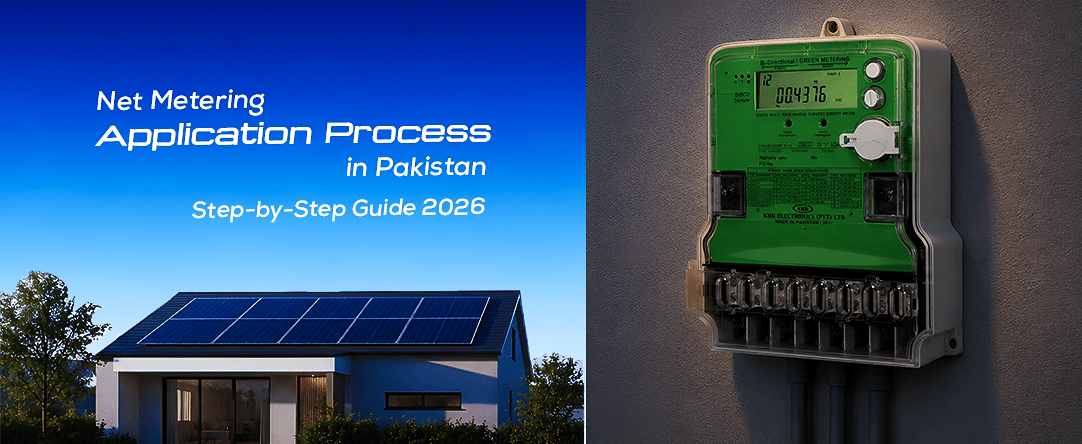
The practical steps for commercial net metering under NEPRA’s 2022 Distributed Generation and Net Metering Regulations are: AEDB system registration, DISCO application with single-line diagram and equipment certifications, DISCO technical inspection, metering agreement, and activation. Max Power manages this documentation process for commercial clients, which typically takes 4 to 12 weeks depending on the DISCO and system size.
For solar energy system Pakistan buyers concerned about the net metering timeline, the system generates and delivers savings from day one of operation even before net metering is activated, as it offsets consumption during generation hours. Net metering adds the export credit component on top.
Explore Max Power’s commercial solar solutions and solar panel range to understand the full product stack available for commercial system design.
What Payback Periods Look Like in 2026
With NEPRA commercial tariffs at current levels and solar system costs at their 2026 pricing, well-designed commercial solar systems in Pakistan are achieving payback periods of 3 to 5 years for on-grid configurations in high-consumption facilities. Hybrid systems with battery storage typically add 1 to 2 years to the payback calculation but deliver the operational continuity that makes them the correct choice for businesses where downtime has a measurable cost.
The businesses achieving the strongest returns are consistently those that went in with accurate load data, a correctly sized system, NEPRA net metering activated, and a supplier capable of post-installation monitoring and performance management.
Frequently Asked Questions
How do I calculate the right solar system size for my commercial facility in Pakistan?
Start with 3 to 6 months of your DISCO electricity bills to establish monthly kWh consumption and identify peak demand months. Divide monthly consumption by 30 for a daily average. Then assess how many hours of sunlight your location receives and what panel efficiency you expect. As a rough guide, a facility consuming 15,000 kWh per month with good solar exposure needs approximately 60 to 75 kW of panel capacity to meaningfully offset its daytime consumption. Max Power’s commercial team can calculate this accurately from your actual bills.
Does commercial net metering work differently from residential in Pakistan?
Yes. Commercial systems above 100 kW require additional NEPRA licensing and AEDB certification steps that are not required for residential applications. The documentation process is more involved, and DISCO review timelines are typically longer. Max Power handles the full AEDB and DISCO documentation process for commercial net metering applications as part of its commercial project delivery.
What is the payback period for commercial solar in Pakistan in 2026?
For on-grid commercial solar systems in facilities with high daytime electricity consumption at current NEPRA tariff rates, payback periods of 3 to 5 years are achievable. Hybrid systems with battery storage add 1 to 2 years. The specific figure depends on your current per-unit cost, system capacity, consumption profile, and whether net metering export revenue is included in the calculation. Max Power can provide a project-specific ROI calculation based on your actual consumption data.
Is Max Power able to handle three-phase commercial solar installations in Pakistan?
Yes. Max Power’s product range includes three-phase on-grid and hybrid inverters through the Voltas and Sofar commercial series, covering applications from 25 kW to 125 kW and above for industrial and large commercial installations. The commercial team handles three-phase system design, load balancing assessment, and DISCO compliance documentation.
What happens to my solar system during extended load shedding if the battery runs out?
A properly configured hybrid inverter prioritizes critical loads and manages the battery down to its BMS protection threshold. Once the battery reaches its minimum state of charge, the inverter continues to run critical circuits from solar generation during daylight hours even without battery backup. When the grid returns, the inverter switches back automatically and begins recharging the battery from solar. The correct system configuration for this scenario should be confirmed with Max Power at the time of installation.
Is Your Business Still Paying Full Grid Rates When Commercial Solar Could Change the Economics?
The commercial solar market in Pakistan has matured to the point where the question is no longer whether solar makes financial sense for businesses. It is the system design that delivers the right combination of bill reduction, operational continuity, and net metering return for your specific facility.
Contact Max Power’s commercial team for a free energy assessment and system proposal based on your facility’s actual consumption data and operational requirements.