Benefits of Commercial & Residential Solar Energy Solutions by MaxPower (2026)
September 29, 2026
Roof Solar vs Ground-Mounted Solar: Pros, Cons, and Which One Is Right for You in Pakistan
September 18, 2026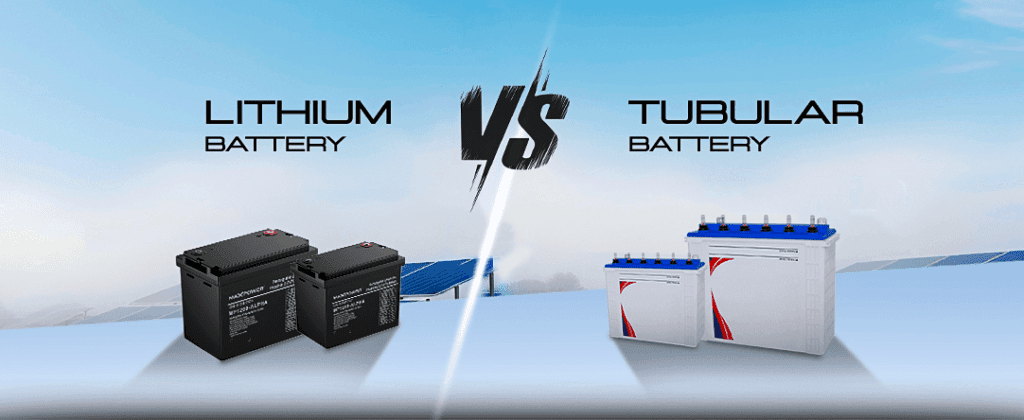
For most Pakistani solar buyers in 2026, the battery choice has shifted decisively toward lithium-ion. Where tubular batteries were once the default backup solution lithium-ion batteries now deliver better performance longer life and lower long term cost per kilowatt-hour. Understanding why requires a clear look at what each technology actually delivers in Pakistan’s specific climate load-shedding patterns and rooftop solar context.
What the Two Technologies Actually Are
Lithium-ion batteries are rechargeable energy storage devices that use lithium as the primary component. They are lighter more energy-dense and maintain performance over thousands of charge discharge cycles. Max Powers lithium-ion batteries, such as the MP-5000 Alpha, are designed specifically for solar energy storage in Pakistan, with nominal voltages of 51.2V, capacities of 100 Ah (5.12 kWh), and cycle lives of 6000 cycles, with up to 10-year lifespans.
Max Power MP-5000 Alpha
Tubular batteries are a type of lead-acid battery with tubular positive plates. They are heavier require regular maintenance topping up distilled water and typically last a few hundred cycles before performance degrades significantly. They have been the traditional choice for UPS and basic solar backup in Pakistan for decades.
Both technologies store energy, but the practical differences emerge in four areas that matter specifically to Pakistani buyers: energy density, space, lifespan and cycle-life performance under frequent cycling, and long-term cost.
The Four Performance Differences That Matter in Pakistan
Energy Density: How Much Backup Per Square Meter
Lithium-ion batteries are significantly more energy-dense than tubular batteries. A single Max Power MP-5000 Alpha (5.12 kWh) occupies roughly the same floor space as a 150–200 Ah tubular battery bank, but delivers 2–3 times more usable energy because lithium ion can be discharged to 80–90% depth of discharge (DoD) without damage while tubular batteries are typically limited to 50% DoD for reasonable lifespan.
In Pakistan’s urban homes, where battery space is often constrained inside a utility room, under stairs, or in a small enclosure lithium ion batteries allow you to fit more backup capacity into the same area. For a typical 5 kW solar system one or two MP 5000 Alpha batteries can provide 5–10 kWh of usable storage whereas achieving the same backup with tubular batteries would require a larger heavier bank and more floor space.
Lifespan and Cycle Life: How Many Load-Shedding Nights
Max Power highlights that lithium-ion batteries offer typically over 2,000 charge cycles and can reach 6,000 cycles in high-quality models like the MP 5000 Alpha compared to a few hundred cycles for traditional lead-acid/tubular batteries.
Max Power Lithium-Ion Game Changer
In Pakistan, where load-shedding can mean daily or near-daily discharge cycles, this difference is critical. A tubular battery bank might last 2–3 years under heavy cycling before capacity drops noticeably. A lithium-ion battery like the MP 5000 Alpha, rated for 6000 cycles can last 8–10 years under similar use effectively 3–4 times longer. Over the 10-year life of a solar system lithium-ion batteries require fewer replacements reducing both hassle and long-term cost.
Performance Under Frequent Cycling: Pakistan’s Load-Shedding Reality
Traditional lead-acid batteries tend to degrade over time with frequent cycling while lithium-ion maintains performance and efficiency for much longer as Max Power notes.
Max Power Lithium-Ion Game Changer
In practice, tubular batteries lose capacity faster when deeply discharged every day. After 12–18 months, you may notice shorter backup times and the need for more frequent equalization charges. Lithium-ion batteries like the MP 5000 Alpha are designed for daily cycling, with stable voltage output and minimal capacity loss over thousands of cycles. They deliver consistent backup hours year after year which is essential for homes and small businesses that rely on solar during load-shedding.
Long-Term Cost: The 10-Year Picture
Lithium-ion batteries have a higher upfront cost per kilowatt-hour than tubular batteries, but their longer lifespan and higher usable capacity change the economics. A typical 5 kWh lithium-ion battery such as the MP-5000 Alpha might cost PKR 250,000–300,000 in 2026. A comparable tubular battery bank providing similar usable capacity might cost PKR 120,000–180,000 but will likely need replacement after 2–3 years.
Over 10 years lithium-ion requires only one battery for 10 years of service, while tubular may need 3–4 replacements, with total cost often exceeding the initial lithium-ion investment. When you factor in lower maintenance higher efficiency and better compatibility with modern hybrid inverter lithium-ion batteries typically offer a lower cost per kilowatt-hour over their lifetime for Pakistani solar systems.
Technical Specs: Max Power Lithium vs Typical Tubular
Here’s how a representative Max Power lithium-ion battery compares with a typical tubular battery used in solar systems in Pakistan:
| Feature | Max Power MP-5000 Alpha (Lithium-Ion) | Typical Tubular Battery (Lead-Acid) |
| Nominal Voltage | 51.2 V | 12V (banks wired in series) |
| Capacity | 100 Ah (5.12 kWh) | 150–200 Ah (1.8–2.4 kWh usable @ 50% DoD) |
| Usable DoD | ~80–90% | ~50% for a reasonable lifespan |
| Cycle Life | 6000 cycles (up to 10 years) | Few hundred cycles (2–3 years under heavy use) |
| Weight | ~48 kg | 50–70 kg per battery |
| Maintenance | Maintenance-free, no watering | Regular water topping, terminal cleaning |
| Efficiency | High (charge/discharge efficiency ~95%) | Lower (~80–85% efficient) |
| Compatibility | Designed for hybrid/off-grid solar systems | Common in basic UPS/solar setups |
Max Power MP-5000 Alpha
Price Comparison in Pakistan 2026
Lithium-ion batteries from quality brands including Max Powers Alpha and Ultra series are available in Pakistan in 2026 at approximately PKR 45,000–60,000 per kWh for residential systems depending on capacity and features. Tubular batteries cost roughly PKR 20,000–35,000 per kWh of usable capacity but with shorter lifespans and higher replacement frequency.
For a 5 kWh usable storage system lithium-ion (eg, MP-5000 Alpha) costs PKR 250,000–300,000 and lasts 8–10 years, while a tubular bank costs PKR 150,000–200,000 but may need replacement every 2–3 years. Over a 10-year period, the total cost of ownership for lithium-ion is often lower, and the performance is consistently better. For any solar system intended to run for more than a few years, lithium-ion is the financially smarter choice.
When Tubular Batteries Still Make Sense
Tubular batteries remain a valid choice in two specific Pakistani contexts. First, very tight budget constraints were the priority is getting any backup in place at the lowest possible upfront cost with the expectation of upgrading to lithium-ion later. Second non-solar backup-only systems (simple UPS) where daily deep cycling is not required and replacement every few years is acceptable.
For every other Pakistani solar buyer in 2026—especially those with hybrid inverters, net metering, and daily load-shedding—lithium-ion is the straightforward recommendation.
Frequently Asked Questions
Are lithium batteries worth the extra cost in Pakistan in 2026?
Yes, for the overwhelming majority of solar buyers. The longer lifespan higher usable capacity, and better performance under frequent cycling mean lithium-ion batteries typically pay back their premium within 2–4 years through reduced replacement costs and better energy utilization. Over a 10-year system life, they are almost always cheaper per kilowatt-hour than tubular batteries.
Which Max Power lithium battery is best for a 5 kW solar system in Pakistan?
For a typical 5 kW residential system, the MP 5000 Alpha (5.12 kWh) is a strong match, providing sufficient storage for evening backup and load-shedding support. Larger systems can use the MP 10000 Alpha (10 kWh) or MP 16000 Alpha (16 kWh) for extended autonomy.
Max Power Lithium-Ion Batteries
Do lithium batteries work in Pakistan’s hot climate?
Yes. High-quality lithium iron phosphate (LiFePO₄) batteries like those used in Max Powers Alpha series, are designed for high temperature operation and include battery management systems (BMS) to protect against overheating. They generally perform better in hot conditions than lead-acid batteries which are more sensitive to temperature and require ventilation.
Can I mix lithium and tubular batteries in the same system?
No. Lithium and tubular batteries have different voltage profiles, charging requirements, and cycle characteristics. They should not be mixed in the same bank. If you are upgrading from tubular to lithium it is best to replace the entire bank and ensure your inverter is compatible with lithium battery settings.
How many lithium batteries do I need for 8–10 hours of backup?
For a typical home using 3–5 kW during load-shedding, 5–10 kWh of usable storage (one or two MP-5000 Alpha batteries) is usually sufficient for 6–10 hours of backup depending on your actual load. Max Power’s system design team can specify the exact battery capacity based on your usage pattern and inverter size.
Lithium or Tubular: Are You Still Asking the Question or Ready to Make the Right Call?
For Pakistans load-shedding reality, rooftop solar economics, and 10-year system life the answer in 2026 is lithium-ion for virtually every buyer who is serious about getting the most out of their solar investment. The technology is now affordable enough that its performance lifespan and low-maintenance advantages win the comparative decisively against tubular batteries.
Explore Max Power’s lithium-ion battery range to specify the right storage solution for your solar system size and backup needs.