Why High Voltage Battery Storage is Replacing Diesel Generators in Modern Hospitals
October 18, 2026
Commercial Solar Backup in Pakistan Unlocking Energy Independence and High ROI with MaxPower
October 14, 2026
Switching to solar power in Pakistan is no longer just an environmental decision; it is a critical household and commercial financial hedge. With grid electricity tariffs steadily rising and unscheduled load shedding disrupting daily life across both urban centres and rural feeders, a dependable solar installation delivers long-term energy predictability and steep bill reductions.
Navigating the Pakistani solar market, however, is genuinely confusing. Prices move with the USD-to-PKR exchange rate, import duties, ocean freight, and technology transitions between panel generations. Comparing turnkey package totals without understanding the underlying equipment leads buyers to overpay for outdated hardware or underspecified balance-of-system components.
This guide breaks down prevailing panel per-watt rates, inverter price bands by capacity, lithium battery costs, and complete turnkey budgets, with benchmarks for MaxPower equipment and the broader market. One caveat before the numbers: every figure below is an indicative market range, not a fixed quotation. Solar component pricing in Pakistan shifts week to week with the exchange rate, so treat these bands as a sanity-check baseline and confirm current quotes before committing.
Current Solar Panel Rates Per Watt in Pakistan
Expanding global manufacturing scale has pushed per-watt photovoltaic module prices steadily downward, making high-efficiency Tier-1 panels accessible to ordinary homeowners. Modern installations now favour N-Type TOPCon, HPBC, and Heterojunction (HJT) bifacial technologies, which offer cell conversion efficiencies between 21% and 23.5% alongside better output retention in ambient summer temperatures exceeding 40°C.
Current retail panel rates fall into three clear technology tiers:
- Tier-1 Premium (HPBC, HJT, ABC): Advanced back-contact architectures such as LONGi Hi-MO X10, Aiko Stellar, and Risen Hyper-ion. These retail between Rs. 41.00 and Rs. 46.20 per watt, or roughly Rs. 26,000 to Rs. 30,500 for a single 580W–720W module.
- Tier-1 Standard (N-Type TOPCon bifacial): The dominant workhorse for modern rooftops, including Jinko Tiger Neo, JA Solar DeepBlue, and Trina Vertex N. These trade between Rs. 39.30 and Rs. 43.50 per watt, translating to about Rs. 24,500 to Rs. 28,500 per module.
- Budget and legacy formats (Mono PERC, polycrystalline): Older stock and unbranded modules sell between Rs. 37.00 and Rs. 40.00 per watt, or Rs. 21,000 to Rs. 24,000 per module. The upfront tag looks attractive, but higher annual degradation and weaker temperature resilience generally deliver poorer lifetime value per rupee spent.
To assess module options for your roof, explore the MaxPower solar panel range and read how to choose the right products for solar installation.
A practical buying rule: evaluate every offer on a per-watt basis — total project cost divided by total DC array wattage — rather than comparing lump-sum package totals. Undersized budget packages often carry an inflated per-watt margin once you inspect component ratings.
How Solar Inverters Fit into System Design
The inverter is the operational brain of the installation. It converts DC from the array into synchronised AC for your appliances, directs battery charging, and manages grid exports through the bi-directional meter.
How your system behaves during a blackout depends entirely on inverter architecture:
- On-grid (grid-tied) inverters feed solar power into your distribution board and export surplus under net metering. When the grid fails, they disconnect immediately for lineman safety, leaving the home dark until supply returns.
- Hybrid inverters connect to panels, grid, and battery bank simultaneously. During outages, an internal transfer switch shifts critical loads to battery in milliseconds.
- Off-grid inverters operate entirely independent of the utility, routing all generation to loads and storage.
For a technical comparison across product lines, see the MaxPower inverter comparison guide.
Solar Inverter Price Benchmarks by Capacity
Inverter pricing varies by rated capacity, topology, phase support, and surge endurance. Indicative current bands:
- 3.0–4.0 kW: Small residences, apartments, single-room cooling, basic loads. On-grid units are rare this small; quality hybrid and off-grid units retail between Rs. 72,000 and Rs. 120,000.
- 5.0–6.0 kW: Typical 5-to-7 Marla homes with one or two inverter air conditioners plus refrigeration and fans. On-grid units trade between Rs. 110,000 and Rs. 140,000; hybrid units between Rs. 120,000 and Rs. 165,000.
- 8.0–10.0 kW: 10 Marla and 1 Kanal residences running three or four air conditioners, water pumps, and full-house lighting. On-grid Rs. 220,000–280,000; hybrid three-phase or heavy-duty single-phase Rs. 255,000–345,000.
- 12.0–15.0 kW: Large residences, farmhouses, and light-commercial loads. On-grid Rs. 320,000–420,000; commercial-grade hybrid Rs. 330,000–605,000 depending on features and parallel scalability.
Note that net-metered systems above 5 kW generally require a three-phase connection, and under current NEPRA rules the system capacity cannot exceed your sanctioned load — so confirm your connection rating before sizing equipment.
MaxPower Hybrid and Off-Grid Inverters
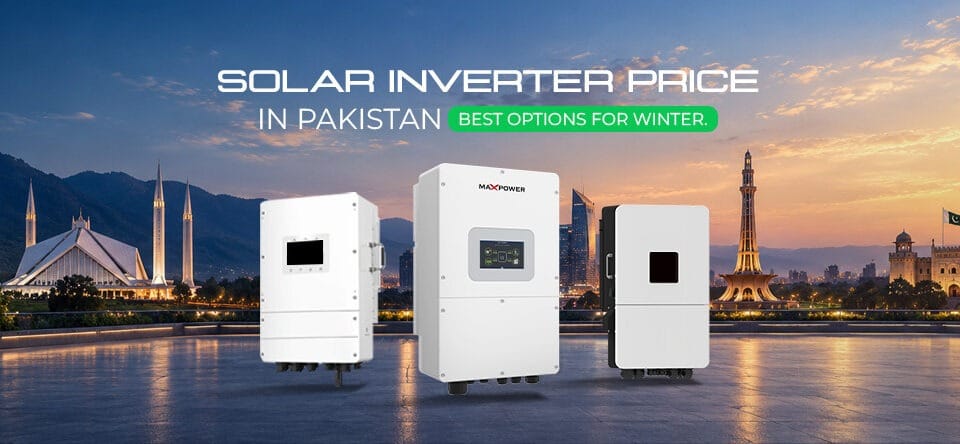
The MaxPower hybrid inverter catalog covers residential and commercial tiers:
- Suntronic PV3000 and PV5000 Pro (3–4 kW): Rs. 72,000–120,000. Compact single-phase units with high-efficiency MPPT charge controllers, wide DC input windows (up to 450V–500V open-circuit), and pure sine wave output safe for sensitive electronics.
- Suntronic PV6000 and PV7000 Pro (6 kW): Rs. 120,000–165,000. Surge overhead engineered to absorb the startup inrush of multiple inverter air conditioners and compressor loads.
- Voltas HYD series (6 kW to 15 kW+): Rs. 255,000–605,000. Heavy-duty single-phase and three-phase Voltas hybrid inverters with dual MPPT trackers, grid-compliant export capability, generator integration terminals, and parallel clustering for large loads.
MaxPower LiFePO4 Energy Storage (Ultra Series)
Lead-acid and tubular batteries degrade rapidly under Pakistan’s daily load-shedding cycling, often falling below half their usable capacity within eighteen to twenty-four months. MaxPower’s LiFePO4 storage offers 80–90% usable depth of discharge, high round-trip efficiency, and 6,000+ cycle durability.
Key benchmarks in the MaxPower lithium battery lineup:
- MP-2500 Ultra (2.56 kWh / 25.6V): Rs. 84,000–105,000 for small backup circuits and apartments.
- MP-5000 Ultra (5.12 kWh / 48V): Rs. 175,000–220,000 — the standard storage block for modern 5–8 kW residential hybrid setups.
- MP-10000 Ultra (10.5 kWh / 48V): Rs. 350,000–430,000, with 6,000 cycles at 80% DoD and native CAN and RS485 communication.
- MP-16000 Ultra (16 kWh / 48V): For 10–15 kW homes requiring overnight air-conditioning backup without grid support.
For wiring, communication setup, and bank sizing, refer to the step-by-step inverter and lithium battery setup guide, and for runtime arithmetic see how to calculate battery backup hours.
Complete Turnkey System Cost Estimates
Solar panels account for only 35% to 45% of total project cost. The balance covers the inverter, mounting structures (galvanised L2/L3 or elevated frames), pure copper DC and AC cabling, distribution boxes with breakers and surge protection, earthing, installation labour, and net-metering processing. Indicative turnkey ranges:
- 5 kW: ~600–700 units per month. On-grid Rs. 5.5–7.0 Lakh; hybrid with 5.12 kWh storage Rs. 9.5–12.5 Lakh.
- 8 kW: ~950–1,100 units per month. On-grid Rs. 8.5–10.5 Lakh; hybrid with lithium Rs. 14.0–18.0 Lakh.
- 10 kW: ~1,200–1,350 units per month. On-grid Rs. 10.0–13.0 Lakh; hybrid with 10 kWh storage Rs. 16.0–21.0 Lakh.
- 15 kW: ~1,800–2,050 units per month. On-grid Rs. 14.5–18.0 Lakh; hybrid with 15–20 kWh storage Rs. 23.0–30.0 Lakh.
For how capacity maps to bill reduction, read how to reduce electricity bills with solar energy, and for sizing methodology, how to choose the right solar system size.
Payback and the New Net Billing Reality
This is the section that changed most, and getting it wrong costs buyers real money.
Grid tariffs for higher consumption slabs commonly run Rs. 40 to Rs. 55 per unit before taxes, and more once taxes and fuel-price adjustments land on the bill. Self-consumed solar displaces those full-tariff units, which remains the core of the investment case.
What changed is the export side. Under the NEPRA (Prosumer) Regulations 2026, Pakistan has moved from one-to-one net metering to a net billing arrangement: units you import are billed at your applicable tariff, while units you export are credited at the national average energy purchase price — materially lower than retail, at roughly Rs. 10–11 per unit in recent determinations. Surplus credit carries to the next billing cycle or is settled quarterly, and system capacity may not exceed your sanctioned load.
Two practical consequences follow. First, oversizing a system for export no longer pays; the financially optimal system is sized to your daytime consumption. Second, battery storage is now economically stronger, not weaker, because a unit of noon solar shifted to evening use via a battery displaces a full-tariff import, while the same unit exported earns only a fraction of that.
Against that framework, realistic payback estimates are roughly 3 to 4.5 years for a well-sized on-grid system with high daytime self-consumption, and 4.5 to 6 years for a hybrid system with lithium storage — with the hybrid figure driven more by energy security than by export revenue. Once capital is recovered, the system produces essentially free electricity for the remaining 20-plus years of its rated life.
Frequently Asked Questions
Which inverter type is better for Pakistani conditions: hybrid or on-grid?
For households facing regular power cuts, a hybrid inverter is the better investment. An on-grid unit delivers bill savings at lower initial cost but shuts down completely during load shedding. A hybrid inverter combines grid-export capability with lithium backup, keeping critical appliances on through outages.
Should I choose N-Type TOPCon panels over Mono PERC?
Yes. TOPCon and HPBC modules exceed 21% conversion efficiency, degrade more slowly (roughly 0.4% annually versus 0.55% for PERC), and hold a better temperature coefficient, producing measurably more kilowatt-hours through extreme summers.
How long does a residential solar system take to pay for itself?
Under the current net billing framework, typically 3 to 4.5 years for on-grid systems with high daytime self-consumption, and 4.5 to 6 years for hybrid systems with battery storage. Households that shift heavy appliance use into daylight hours shorten these periods considerably.
Do batteries still make sense if export rates have fallen?
Yes — more than before. Exported units now earn only the national average energy purchase price, while a unit stored at noon and used at night displaces a full-tariff import. Storage converts cheap-to-export solar into expensive-to-buy avoided grid units.
What factors drive solar price fluctuations in Pakistan?
USD-to-PKR movement, global silicon wafer supply and ocean freight rates, import duties, and seasonal demand spikes in the pre-summer installation rush.
Why choose MaxPower over unverified imports?
Wide voltage tolerance and high-temperature dissipation engineered for local conditions, genuine manufacturer warranty backing, available spare parts, and accessible technical support across Pakistan — protections grey-market imports cannot offer.