Top 10 Solar Energy Companies in Pakistan 2026 Guide
July 11, 2026
Top 7 Mistakes to Avoid When Buying Lithium Batteries in Pakistan
July 7, 2026How to Calculate Backup Time for Lithium Batteries: A Step-by-Step Guide for Pakistani Homes
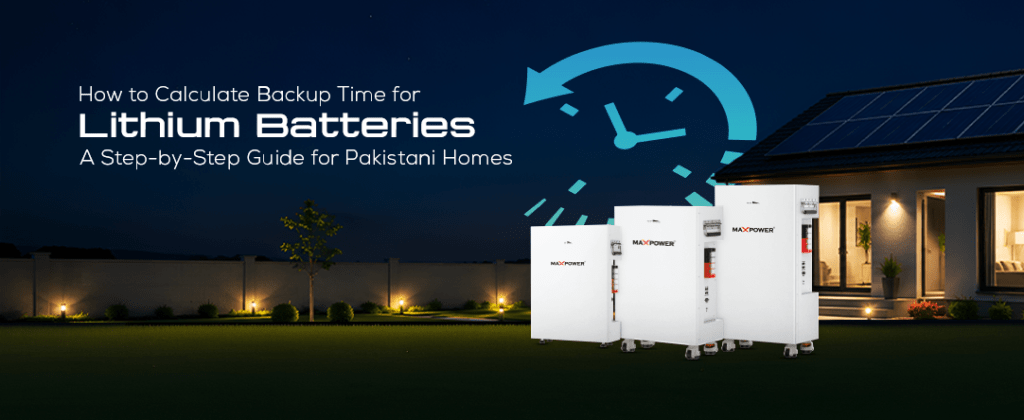
One of the most common complaints from Pakistani solar users is that their battery “runs out too early” during load shedding. In many cases, the battery is not faulty. The real problem is that the battery was either undersized for the home’s actual electricity load or the expected backup time was calculated incorrectly before purchase.
Knowing how to calculate solar battery backup time takes only a few minutes and can help you choose the right lithium battery capacity for your home, especially if you use fans, lights, a refrigerator, TV, Wi-Fi and an inverter AC during load shedding.
This practical guide explains the solar battery backup time formula, usable battery capacity, inverter efficiency, temperature effects and real-world examples for Pakistani homes.
How Is Solar Battery Backup Time Calculated?
The basic formula is:
Backup Time (hours) = Usable Battery Capacity (kWh) ÷ Load (kW)
For a more realistic estimate, include inverter efficiency and environmental derating:
Realistic Backup Time = (Rated Battery Capacity × Usable DoD × Inverter Efficiency × Temperature Factor) ÷ Load
For example, a 10 kWh lithium battery used at 80% depth of discharge with a 90% inverter efficiency factor provides:
10 × 0.80 × 0.90 = 7.2 kWh effective backup energy
At a continuous 1.6 kW load:
7.2 ÷ 1.6 = approximately 4.5 hours
Actual backup time can vary depending on appliance cycling, battery temperature, inverter performance, battery age and the actual load at any moment.
Why Your Solar Battery May Run Out Earlier Than Expected
Battery backup is not determined by battery size alone. Three numbers matter most:
- Battery capacity: How much energy the battery stores, measured in kWh.
- Usable depth of discharge (DoD): How much of that stored energy can normally be used.
- Household load: How much electricity your appliances consume, measured in kW.
A 10 kWh battery does not necessarily provide 10 kWh of usable AC energy. For example, if an installation is designed around 80% usable capacity and a 90% inverter-efficiency assumption, the effective energy available to the AC loads is approximately:
10 kWh × 80% × 90% = 7.2 kWh
That distinction is important when estimating backup during Pakistan’s load-shedding periods.
Step 1: Find Your Battery’s Usable Capacity
Rated Capacity vs. Usable Capacity
Rated battery capacity and usable battery capacity are not always the same.
For example:
10 kWh rated lithium battery × 80% usable DoD = 8 kWh usable DC energy
After allowing for a 90% inverter efficiency assumption:
8 kWh × 90% = 7.2 kWh effective AC energy
This is why two batteries with similar rated capacity can produce different real-world backup times.
Max Power’s current product range includes lithium battery models such as the MP-10000 Alpha, MP-16000 Alpha, MP-20024 Alpha/Ultra variants and MP 32000 Ultra/PRO variants. Specifications can differ by exact model and generation, so the product datasheet should always be checked before making a final sizing decision.
For the examples below, an 80% usable-capacity assumption is used consistently to demonstrate the calculation.
Example Battery Capacities
- MP-2500 class: approximately 2.5 kWh nominal capacity
- MP-10000 Alpha: approximately 10 kWh nominal capacity
- MP-16000 Alpha: 16 kWh nominal capacity
- MP-20024: approximately 20 kWh class
- MP-32000 Ultra: 32 kWh nominal capacity
The MP-16000 Alpha is officially listed at 51.2V, 314Ah and 16 kWh, while the MP-32000 Ultra is listed at 51.2V, 628Ah and 32 kWh. Both official pages also specify 80% DoD-related cycle information.
Step 2: Calculate Your Home’s Backup Load in kW
Before choosing a solar battery, list the appliances you expect to operate during load shedding.
For a typical Pakistani home, an example load profile could look like this:
- 4 ceiling fans × 75W = 300W
- 8 LED lights × 12W = 96W
- Refrigerator average running consumption = 150W
- Television = 100W
- Wi-Fi router = 20W
- 1.5-ton inverter AC, running average = 900W
Total Running Load
300 + 96 + 150 + 100 + 20 + 900 = 1,566W
That is approximately:
1.57 kW, or about 1.6 kW
Remember that appliance ratings are not always equal to actual continuous consumption. Refrigerators cycle on and off, while inverter ACs can vary their power consumption according to room temperature and set temperature.
For the most accurate solar battery backup calculation, measure your actual load using your inverter’s monitoring screen or an appropriate energy meter.
Step 3: Calculate Basic Battery Backup Time
Now apply the basic formula:
Backup Time = Usable Battery Capacity ÷ Load
Suppose you have a 10 kWh lithium battery and use an 80% usable-capacity assumption:
10 kWh × 80% = 8 kWh usable energy
For a 1.6 kW household load:
8 ÷ 1.6 = 5 hours
So the theoretical backup time is approximately 5 hours before inverter losses and other derating factors.
Step 4: Include Inverter Efficiency
Your hybrid inverter converts DC electricity from the battery into AC electricity used by household appliances. This conversion is not 100% efficient.
For planning purposes, using a 90% efficiency assumption gives a more conservative estimate:
Adjusted backup time = (8 kWh × 90%) ÷ 1.6 kW
= 4.5 hours
Therefore, instead of planning around the theoretical 5-hour figure, approximately 4.5 hours is a more conservative estimate under these assumptions.
Actual inverter efficiency depends on the specific inverter, operating point and system conditions.
Step 5: Consider Temperature and Summer Conditions
Pakistan’s summer temperatures can be very high, and battery operating conditions can affect available energy and system performance.
LiFePO4 batteries are designed to operate across specified temperature ranges, but the installation environment still matters. A battery installed in a poorly ventilated, extremely hot location may not perform exactly like one operating under controlled conditions.
For conservative summer planning, some installers may apply an additional derating factor.
Using a simple 5% planning factor:
4.5 × 0.95 = 4.28 hours
Rounded:
Approximately 4.3 hours
This is a planning estimate rather than a guaranteed runtime. Actual results depend on battery temperature, battery condition, inverter efficiency and the changing household load.
Complete Solar Battery Backup Example for a Pakistani Home
Let’s use the same 1.6 kW household load, 80% usable capacity, 90% inverter efficiency and a 5% summer planning factor.
MP-10000 Alpha
Approximate usable energy:
10 × 0.80 = 8 kWh
Summer-adjusted effective energy:
8 × 0.90 × 0.95 = 6.84 kWh
Backup:
6.84 ÷ 1.6 = approximately 4.3 hours
MP-16000 Alpha
Usable energy:
16 × 0.80 = 12.8 kWh
Summer-adjusted effective energy:
12.8 × 0.90 × 0.95 = 10.94 kWh
Backup:
10.94 ÷ 1.6 = approximately 6.8 hours
The official MP-16000 Alpha specification lists 16 kWh nominal capacity, 150A recommended charge current, 200A discharge current and a standard 5-year warranty.
MP-20024
Using a 20 kWh planning capacity:
20 × 0.80 × 0.90 × 0.95 = 13.68 kWh effective energy
At 1.6 kW:
13.68 ÷ 1.6 = approximately 8.6 hours
MP-32000 Ultra
The official MP-32000 Ultra is rated at 32 kWh nominal capacity and specifies 80% DoD for its cycle-life claim.
Using the same planning assumptions:
32 × 0.80 × 0.90 × 0.95 = 21.89 kWh
At 1.6 kW:
21.89 ÷ 1.6 = approximately 13.7 hours
Estimated Backup Time at a 1.6 kW Load
| Battery | Nominal Capacity | Planning Backup* |
|---|---|---|
| MP-2500 class | ~2.5 kWh | ~1.1 hours |
| MP-10000 Alpha | ~10 kWh | ~4.3 hours |
| MP-16000 Alpha | 16 kWh | ~6.8 hours |
| MP-20024 class | ~20 kWh | ~8.6 hours |
| MP-32000 Ultra | 32 kWh | ~13.7 hours |
*Planning estimate based on 80% usable capacity, 90% inverter efficiency and 5% additional summer derating at a constant 1.6 kW load. Actual runtime will vary.
How Much Does an AC Reduce Solar Battery Backup Time?
An air conditioner can dramatically reduce battery runtime.
In our example, the home load without AC is:
1.6 kW − 0.9 kW = approximately 0.7 kW
Adding a 1.5-ton inverter AC at an assumed 900W average increases the load to approximately:
1.6 kW
If another high-power appliance is added, the load can quickly rise above 2 kW.
For example, with a 2.5 kW load and an MP-10000 Alpha:
6.84 ÷ 2.5 = approximately 2.7 hours
That is significantly lower than the approximately 4.3-hour estimate at a 1.6 kW load.
This is why battery sizing should always be based on the appliances you actually intend to run during load shedding, rather than simply choosing a battery based on the inverter’s kW rating.
How Many kWh Do You Need for 8 or 10 Hours of Backup?
The calculation becomes simple when you know your average load.
For a 2 kW load and 10 hours:
2 kW × 10 hours = 20 kWh
You need approximately 20 kWh of usable AC energy.
If you plan around 80% usable battery capacity and 90% inverter efficiency:
Required rated capacity = 20 ÷ (0.80 × 0.90)
= approximately 27.8 kWh
If you also apply a 5% summer planning factor:
20 ÷ (0.80 × 0.90 × 0.95) = approximately 29.2 kWh
This illustrates why a nominal 32 kWh battery can be a more comfortable match for a sustained 2 kW load over a 10-hour outage, subject to the actual battery/inverter specifications.
What Is the Best Battery Size for Load Shedding in Pakistan?
There is no single battery size that is best for every Pakistani home.
Your ideal solar battery size depends on:
- Average load in kW
- Peak load in kW
- Required backup hours
- Number of AC units
- Refrigerator and freezer usage
- Water pumps and other motors
- Battery chemistry and usable DoD
- Inverter efficiency
- Available solar generation for recharging
- Whether the battery must recharge fully between outages
As a general starting point:
- Small essential loads: around 2–5 kWh
- Medium household backup: around 5–10 kWh
- Large home with longer backup: around 10–20 kWh
- Heavy residential or commercial backup: 20 kWh and above
The actual requirement should be calculated from your appliance list rather than from house size alone.
Solar Battery Backup Time Formula: The Simple Version
If you only remember one calculation, remember this:
Battery Backup Time = (Battery kWh × Usable DoD × Inverter Efficiency) ÷ Load kW
For summer planning, you can add an additional temperature/environment factor:
Practical Backup Time = (Battery kWh × DoD × Inverter Efficiency × Derating Factor) ÷ Load kW
For example:
10 × 0.80 × 0.90 × 0.95 ÷ 1.6 = approximately 4.3 hours
This is the easiest way to estimate how long a lithium battery will last during load shedding in Pakistan.
What About Peak Load and Starting Current?
Backup energy and maximum power are two different things.
A battery may have enough stored energy in kWh but still be unsuitable if the inverter or battery cannot handle the instantaneous power demand.
Refrigerators, water pumps and other motor-driven appliances can briefly require more power when starting. Therefore, battery selection should consider both:
Energy capacity (kWh) — how long the battery can provide power.
Power capability (kW) — how much power the battery/inverter can provide at one time.
A proper solar installer should therefore check both your daily energy requirement and your maximum/peak load before recommending a battery.
How to Improve Your Battery Backup Time
If your battery is running out sooner than expected, increasing battery capacity is not always the first solution.
Try these steps:
- Reduce non-essential loads during load shedding.
- Avoid running multiple high-power appliances simultaneously.
- Use your inverter’s monitoring data to identify high loads.
- Keep the battery and inverter installed according to the manufacturer’s environmental requirements.
- Check whether the battery is reaching the expected state of charge during the day.
- Verify the inverter’s battery settings and communication with the BMS.
- Compare your measured load with the original battery-sizing calculation.
If the measured load consistently exceeds the original design load, the system may simply need additional storage.
Frequently Asked Questions
How do I calculate lithium battery backup time in Pakistan?
Multiply the battery’s rated kWh by its usable depth of discharge and inverter efficiency, then divide by the household load in kW.
For example:
10 kWh × 80% × 90% ÷ 1.6 kW = 4.5 hours
For a more conservative summer estimate, an additional derating factor can be applied.
How many kWh battery do I need for 8 hours of backup?
It depends on your average load. An 8-hour backup at 1 kW requires approximately 8 kWh of usable AC energy. At a 2 kW load, the requirement doubles to approximately 16 kWh of usable AC energy.
The battery’s rated capacity must be higher because usable DoD and inverter losses need to be considered.
Which Max Power battery is suitable for 8 hours of backup?
The answer depends on your actual load. At approximately 1.6 kW, an MP-16000 Alpha gives a planning estimate of around 6.8 hours under the assumptions used in this guide, while a 20 kWh-class battery gives roughly 8.6 hours. The official MP-16000 Alpha is rated at 16 kWh nominal capacity.
For a higher load, you may need more battery capacity even if the outage duration is the same.
Does running an inverter AC reduce lithium battery backup time?
Yes. An inverter AC can become one of the largest loads in a Pakistani home. The higher the average AC consumption, the faster the battery’s stored energy is depleted.
For accurate sizing, use the AC’s actual average running consumption, rather than assuming its maximum rated wattage.
Why does my solar battery provide less backup than the advertised capacity?
Rated battery capacity is not the same as usable AC energy. Backup time can be reduced by the battery’s usable DoD, inverter conversion losses, temperature, battery condition, appliance cycling and the actual household load.
For this reason, a 10 kWh battery should not automatically be expected to deliver 10 kWh of usable AC energy to your appliances.
Final Takeaway: Size Your Battery for Your Actual Load
The most reliable way to calculate solar battery backup time in Pakistan is to start with your real appliance load, determine the battery’s usable energy, account for inverter losses and then allow for realistic operating conditions.
The core formula is:
Practical Backup Time = (Battery Capacity × Usable DoD × Inverter Efficiency × Derating Factor) ÷ Load
A correctly sized lithium battery can provide dependable backup during load shedding, but the right capacity depends on what you actually run—not simply on the size of your solar system or home.
If your current battery does not cover your required outage window, compare your measured load with your original sizing calculation before deciding whether you need additional battery capacity.
Explore Max Power’s current lithium battery range and get a battery-sizing recommendation based on your actual appliance list, inverter and expected load-shedding duration. Max Power currently lists MP-series lithium batteries across residential and larger energy-storage applications.