How Max Power Solar Systems Support Commercial & Industrial Energy Needs
April 8, 2026
Why Businesses in Pakistan Are Switching to High-Voltage Hybrid Solar Systems
March 25, 2026Lithium-Ion vs Lead-Acid Batteries: Why Max Power Lithium Batteries Are Better for Pakistan
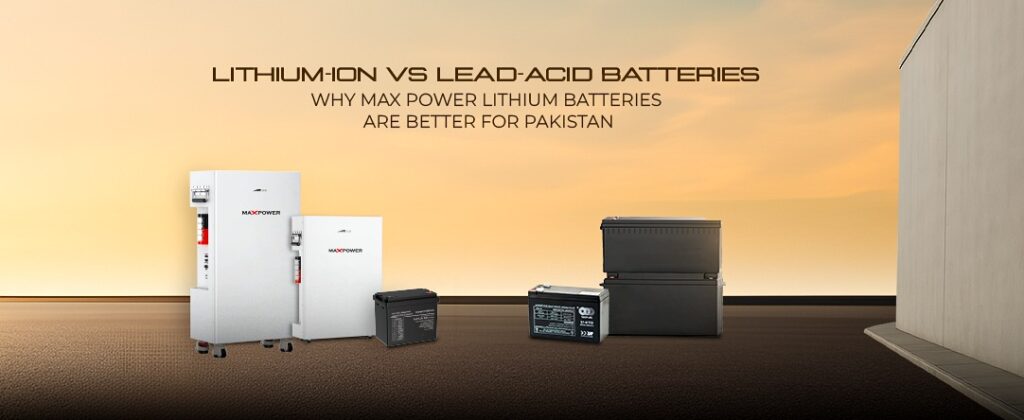
If you have been shopping for a solar battery in Pakistan in 2026, you already know the conversation always comes down to the same two options: lead-acid or lithium-ion. One is familiar, widely available, and cheap upfront. The other costs more initially but performs in ways that make the price difference fade when you run the actual numbers over time.
This is not a theoretical debate. Millions of Pakistani homes and businesses have gone through this decision, and the direction the market is moving is clear. The question is not whether lithium-ion is better. It is whether you understand exactly how and why, so you can make a confident decision for your specific setup.
Let us go through this properly.
What Lead-Acid Batteries Actually Cost You Over Time
The Cheap Battery That Keeps Asking for More
Lead-acid batteries, including the tubular variants widely used in Pakistani home UPS and solar setups, have one genuine advantage: low upfront cost. A decent tubular battery in Pakistan runs between PKR 55,000 and PKR 85,000 per unit. For a typical home load, you might need two to four of these. The math looks manageable at first.
However, this is where the problem arises. Lead-acid batteries have a shorter lifespan of two to three years and can only handle 300 to 500 charge cycles, while lithium-ion batteries can safely discharge up to 80 to 100% of their capacity compared to 50% for lead-acid without damaging the battery.
That 50% depth of discharge limitation is not a minor footnote. It means that if you buy a 200Ah lead-acid battery, you can only reliably use 100Ah of it in daily cycling. The battery you paid for is only half a battery in practical terms. Combine this with a two- to three-year replacement cycle, and the cost of lead-acid over a decade is not cheap at all.
You also need to factor in maintenance. Lead-acid batteries require regular water top-ups, proper ventilation because they release hydrogen gas during charging, and careful monitoring to prevent sulfation. That is time, attention, and potential risk, especially in hot climates.
Why Lithium-Ion Is a Different Product Entirely
The Technical Case in Plain Language
Lithium-ion battery technology, specifically LiFePO4 (lithium iron phosphate), is what Max Power’s battery range is built on. LiFePO4 is the safest lithium chemistry available, with thermal stability that matters a great deal in Pakistan’s summer temperatures.
Here is what changes when you switch:
- Cycle life: A quality lithium-ion battery in Pakistan delivers 3,000 to 6,000 cycles. At one cycle per day, that is eight to sixteen years of service. Lead-acid gives you 300 to 500 cycles, which is under two years at the same rate.
- Depth of discharge: You can use 80 to 100% of a lithium battery’s rated capacity. The 200Ah you paid for is the 200Ah you get.
- Efficiency: Lithium-ion round-trip efficiency runs at around 95 to 98%. Lead-acid sits at 75 to 80%. Your solar panels are working harder to charge a lead-acid bank.
- Charge speed: A lithium battery charges in two hours or less under proper conditions. Lead-acid of similar capacity takes six to eight hours.
- Weight and space: Lithium batteries are significantly lighter and more compact, which is relevant for rooftop and confined-space installations.
- Maintenance: Zero. No water checks, no ventilation requirements, no sulfation concerns.
The Real Cost Comparison Over Ten Years
A good lithium-ion battery for solar prices in Pakistan starts at around PKR 280,000 for a 48V 3 kWh pack, with larger 5 kWh systems running PKR 450,000 to PKR 550,000. That sounds expensive against PKR 65,000 for a tubular battery.
But run the ten-year math. A lead-acid bank is replaced three to four times over a decade, plus maintenance expenses and energy losses from lower efficiency, versus a single lithium pack that runs the full decade with no replacement. The best battery for solar in Pakistan over a ten-year horizon is not the one with the lower sticker price.
What Max Power Lithium Batteries Bring to This Equation
Max Power’s 12V 200Ah lithium-ion battery price range in Pakistan and its broader lithium storage lineup are specifically designed for the country’s grid conditions. The built-in Battery Management System (BMS) automatically takes care of balancing the battery cells, protecting against overcharging, monitoring temperature, and preventing short circuits—
The BMS also ensures compatibility with a wide range of hybrid and on-grid inverters, including Max Power’s own inverter lineup, making system integration clean and reliable.
This is exactly why lithium technology is increasingly considered a game-changer in Pakistan’s solar landscape—offering higher efficiency, longer lifespan, and minimal maintenance compared to traditional batteries. Learn why lithium-ion batteries are considered a game changer
Frequently Asked Questions
Is a lithium-ion battery worth it in Pakistan?
Yes, this type of battery is especially useful for daily load shedding. Over time, lithium costs less than repeatedly replacing lead-acid batteries.
Do Max Power lithium batteries handle extreme heat?
Yes. Their LiFePO4 chemistry is heat-stable, and the built-in BMS ensures safe operation.
Lithium-ion vs. LiFePO4—what’s the difference?
LiFePO4 is a safer, longer-lasting type of lithium-ion, ideal for solar systems.
How to check inverter compatibility with lithium batteries?
Check voltage range and communication protocol. Most modern hybrid inverters support lithium batteries.
Still Running Lead-Acid When a Better Option Exists?
The battery market in Pakistan has moved. Lead-acid made sense a decade ago when lithium was rare and expensive. In 2025, the gap has narrowed enough that the lithium ion battery price in Pakistan is now a genuine long-term investment, not a luxury.
Get in touch with Max Power to find the right lithium battery size and configuration for your home or business solar system. The team will walk you through the numbers honestly so you can decide with confidence.