How to Clean Solar Panels for Maximum Output in Pakistan
September 6, 2026
Common Solar Inverter Installation Mistakes Pakistani Homeowners Make (And How to Avoid Them in 2027)
August 28, 2026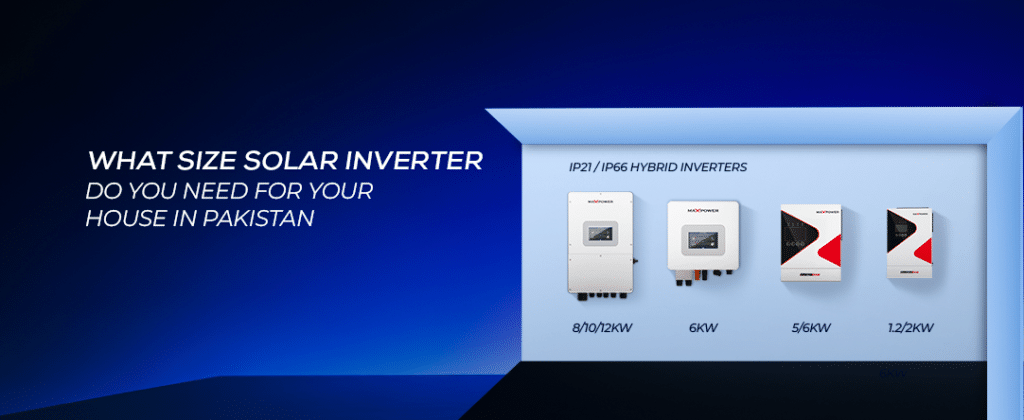
Most Pakistani homes need a solar inverter between 1.5 kW and 12 kW, depending on how many appliances run at the same time. The right size comes from your actual load, not from your house size alone. An undersized inverter trips during load shedding when several appliances start together, while an oversized one costs more than necessary and can run less efficiently at partial load. This guide shows you how to calculate the right size step by step, with a practical size guide for apartments, marla and kanal homes, and small offices.
List Your Simultaneous Running Loads
Write down every appliance you will run at the same time during peak usage, which in most Pakistani homes is the evening, when the grid is most likely to fail. A typical 10 marla home during load shedding might run four ceiling fans at 75W (300W), ten LED lights at 12W (120W), a refrigerator at 150W, a television at 100W, a WiFi router at 20W and one 1.5-ton inverter AC at 900W to 1,200W while running. That adds up to a total running load of about 1,590W to 1,890W.
Find Your Highest Startup Draw
Your highest startup draw decides how much surge capacity you need. Air conditioner compressors, refrigerator compressors and pump motors draw two to three times their running wattage for two to three seconds when they start. A 1.5-ton inverter AC running at 900W may draw 3,000W to 4,000W at startup. Your inverter must handle this surge without tripping, so check the surge rating (listed in kVA in the spec sheet) and confirm that it comfortably exceeds your highest startup draw.
Add a 20% to 30% Capacity Buffer
An inverter that runs at 90% to 100% of its rated capacity every day runs hotter, stresses its components more and has a shorter service life than one running at 60% to 80%. Add 20% to 30% to your calculated peak load to find the minimum inverter size. In the example above, 1,890W × 1.25 gives about 2,362W, which points to a 3 kW inverter as the absolute minimum for those basic loads. If you add a second AC unit or a washing machine during load shedding, you quickly need 5 kW to 6 kW of capacity. This is why most 10 marla homes with air conditioning end up in the 5 kW to 8 kW range.
Solar Inverter Size Guide for Pakistani Homes
Choosing the right inverter size is not about buying the biggest system available. It should match your home’s real peak load, your appliance usage and your future needs. Use this guide to estimate the most suitable range for your property.
Apartment or small flat: the typical peak load is 800W to 1,200W, so a 1.5 kW to 3 kW inverter is suitable for lights, fans, TVs, a refrigerator and basic daily usage.
5 marla house with 1 AC: the typical peak load is 1,500W to 2,000W, so a 3 kW to 5 kW inverter works for households running essential appliances with moderate cooling demand.
10 marla house with 1 to 2 ACs: the typical peak load is 2,000W to 4,000W, so a 5 kW to 8 kW inverter suits medium-sized homes with extended daytime and evening usage.
1 kanal house with 2 to 3 ACs: the typical peak load is 4,000W to 7,000W, so an 8 kW to 12 kW inverter is ideal for larger households with multiple rooms and higher cooling needs.
Small office or shop: the typical peak load is 2,000W to 5,000W, so a 5 kW to 10 kW inverter supports business continuity and daytime commercial operations.
Single-Phase or Three-Phase Inverter?
Most Pakistani residential properties run on a single-phase grid connection. Maxpower’s Voltas hybrid inverters, including the Voltas HYD-8K-H6 PRO and Voltas 8K-H4, cover the mainstream 8 kW single-phase residential segment. For commercial properties with a three-phase connection, the Voltas HYD-15K-H6 and Voltas 14K-H4 are the appropriate three-phase options.
If you are not sure which connection you have, check your DISCO electricity meter. Single-phase meters usually have two wires and three-phase meters usually have four. You can also check your electricity bill, which on commercial accounts states the connection type.
Size for Future Load, Not Just Current Load
If you plan to add a second AC unit, an electric vehicle charger or more office equipment in the next two to three years, size the inverter for that future state now. Replacing an undersized inverter early is far more expensive than choosing the next size up at purchase. Remember that the inverter is only one part of the system, so plan your solar panels and lithium batteries together with it. If you want to export extra power to the grid, see our net metering solutions. You can also explore the full Maxpower solar inverter range for every capacity from compact residential to large commercial.
Frequently Asked Questions
How do I calculate the right solar inverter size for my home?
List the appliances you run at the same time at peak usage, add up their running wattage, then add a 20% to 30% buffer. Also check the highest startup draw (such as an AC or pump) against the inverter’s surge rating in kVA.
What size inverter do I need for a 10 marla house in Pakistan with one AC?
A 10 marla home with one 1.5-ton inverter AC and standard household loads typically needs a 5 kW to 8 kW hybrid inverter. The Voltas HYD-8K-H6 PRO at 8 kW is a well-matched option with headroom for load growth. For a more economical option, Maxpower’s PV Tech series covers 5 kW to 6 kW capacity for indoor installation.
Can I use a 5 kW inverter for two air conditioners?
Typically no. Two 1.5-ton inverter AC units have a combined running load of about 1,800W to 2,400W, with startup surges of 6,000W to 8,000W. A 5 kW inverter handles this borderline at best and may trip on simultaneous startups, so an 8 kW to 10 kW inverter is the safer choice for two ACs running together.
Does inverter size affect how much electricity I save from solar?
Inverter size decides how much AC power the system can deliver to your loads. A larger inverter paired with a larger panel array generates more electricity and more bill savings, but an oversized inverter that does not match the panel array and load does not save proportionally more. The system works best when inverter, panel and battery capacity are sized together.
Is a 3 kW or 5 kW inverter better for a 5 marla home?
For a 5 marla home with one small AC, fans, lights and standard appliances, a 5 kW inverter gives appropriate headroom for simultaneous use and future growth. A 3 kW inverter works for basic loads without AC. If you may add a first or second AC within three years, starting at 5 kW avoids early replacement.
Should I choose a single-phase or three-phase inverter?
Choose single-phase if your property has a single-phase meter, which is typical for homes. Choose three-phase if your property has a three-phase connection, which is common for factories, offices and larger commercial buildings.
Do You Know Your Peak Load Before Choosing Your Inverter Size?
Most inverter sizing mistakes in Pakistan come from one cause: the load was not calculated before the inverter was chosen. Spend 10 minutes listing your simultaneous loads, identify the appliance with the highest startup draw and add a 25% buffer. That gives you the minimum inverter size to consider. Contact Maxpower for a free load assessment and inverter sizing recommendation.