📅 Sep 3, 2020
Selecting the best solar panels
September 3, 2020 📅 Sep 3, 2020
The advantages of having clean solar power in your home
September 3, 2020
Evaluating Solar Panel Efficiency & Feasibility in Pakistan
When evaluating solar panels, efficiency is one of the most important criteria—but it’s not the only one. You also need to consider durability, manufacturer assurance, and how well the panels fit your site conditions and budget. In Pakistan, where solar energy is increasingly used to combat load shedding and high electricity costs, understanding solar panel efficiency and feasibility is crucial for making a smart investment.
This article explains how solar panel efficiency is calculated, what factors affect it, and how to conduct a solar feasibility study for your home or business in Pakistan.
Solar Screening and Feasibility Study
Before installing a solar power system, a proper solar screening and feasibility study helps ensure that your investment is technically and economically sound. Integrating high-efficiency solar panels with reliable energy hardware featured across Maxpower solutions—such as advanced hybrid inverters and long-lasting lithium batteries—ensures maximum energy capture and dependable backup.
Structural and Mechanical Considerations
For a rooftop solar system, you should consider:
-
Roof Condition: Is the roof strong enough to support the solar panels and mounting structure?
-
Roof Age and Warranty: Will the roof need replacement soon, which could require removing and reinstalling panels?
-
Shading Analysis: Identify obstructions like trees, neighboring buildings, or chimneys that could shade the solar array.
-
System Size and Height: For high‑rise buildings, consider wind load, safety, and access for installation and maintenance.
Economic Screening
Economic analysis helps determine whether a solar system makes financial sense:
-
Cost of electricity at your location and whether there are tariffs or rates that penalize solar power.
-
Key economic metrics such as:
-
Net Present Value (NPV)
-
Internal Rate of Return (IRR)
-
Life Cycle Cost (LCC)
-
Payback period
-
-
Annual energy production estimates and potential savings on electricity bills. For a deeper breakdown on calculating ROI and bill savings, read our comprehensive guide on solar inverter selection & ROI analysis.
Solar Feasibility Checkpoint
| Feasibility Element | Key Considerations | Practical Impact in Pakistan |
| System Capacity | Total power generation vs. peak daily load demand | Determines solar inverter size (e.g., 5kW to 10kW) |
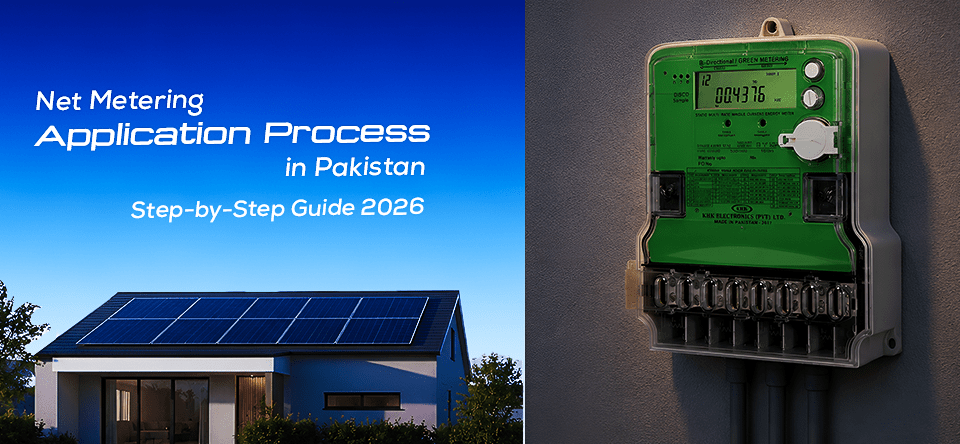
| Grid & Net Metering | Bi-directional meter compatibility and DISCO regulations | Allows selling surplus solar electricity back to the national grid |
| Energy Storage | Battery capacity analysis (Lithium LiFePO4 vs. Tubular Lead-Acid) | Guarantees uninterrupted power supply during unexpected outages |
| Maintenance & O&M | Routine cleaning schedule and electrical connection checks | Preserves system conversion efficiency over a 25-year lifespan |
Understanding Solar Panel Efficiency
Solar panel efficiency measures how effectively a panel converts sunlight into usable electricity. Higher efficiency means you generate more power from the same surface area, which is especially valuable when roof space is limited.
How Efficiency is Calculated
Under Standard Test Conditions (STC), efficiency is calculated using the following formula:
Where:
-
Module Power: Rated power output of the panel (e.g., 400W).
-
Width × Length: Total surface area of the panel in square meters ($\text{m}^2$).
-
$1000\ \text{W/m}^2$: Standard solar irradiance benchmark used for factory testing.
Calculation Example:
A 400W panel measuring $1\text{ m} \times 2\text{ m}$ has an area of $2\text{ m}^2$.
Benefits of Higher Efficiency
-
More Power Output from Smaller Areas: Ideal for urban residential rooftops with restricted space.
-
Fewer Panels Needed: Reduces mounting structure complexity, wiring runs, and installation costs.
-
Better Low-Light Performance: Delivers better output during early morning hours, late afternoon, or cloudy days. For related insights on seasonal performance, check our guide on maximizing solar power efficiency in winter.
Key Factors Affecting Solar Panel Efficiency in Pakistan
Several environmental and operational factors influence how well your solar system performs in real-world conditions:
-
Shade Management: Shade significantly reduces solar panel output. Even partial shading on one panel can lower the yield of an entire series string. Pairing your solar panels with high-efficiency Maxpower solar inverters equipped with advanced MPPT controllers helps maximize power generation under uneven lighting conditions.
-
Roof Pitch (Tilt Angle): In Pakistan, the optimal solar panel tilt angle generally matches the local latitude (~30° for central and northern regions). Adjustable mounting structures help optimize seasonal exposure.
-
Orientation: South-facing solar panels capture maximum sunlight throughout the day across the Northern Hemisphere. East and west orientations can also be utilized for morning or evening peak generation.
-
Lifespan and Degradation: Tier-1 solar panels experience light degradation over time, usually losing around 0.5% efficiency per year while maintaining 80–85% of rated capacity after 25 years.
-
Dust & Environmental Maintenance: Dust, pollution, and dirt buildup block light transmission. Regular washing with water and a soft brush maintains peak conversion levels.
-
Temperature Coefficient: High ambient temperatures lower photovoltaic efficiency. Installing panels with adequate clearance off the roof ensures airflow to minimize thermal losses during intense summer weather.
Conclusion
Investing in a solar system offers an extraordinary return on investment by maximizing power output while significantly reducing energy bills. While efficiency is a key criteria, it must be evaluated alongside site conditions, tilt, shading, and financial feasibility. By conducting a thorough feasibility study and pairing high-efficiency solar panels with reliable inverter systems, homes and businesses across Pakistan can secure long-term energy independence. Explore more tutorials on setup, battery integration, and maintenance on the official Maxpower Blog.
Frequently Asked Questions
What is considered a good solar panel efficiency rate?
Most modern residential solar panels offer efficiency rates between 19% and 23%. High-efficiency panels (above 21%) are ideal if you have limited roof space and want to maximize overall power output.
How does hot weather in Pakistan affect solar panel efficiency?
Solar panels are rated at standard testing conditions of 25°C. When ambient temperatures rise, panel output drops slightly based on its temperature coefficient. Ensuring proper space beneath the panels for airflow helps mitigate heat loss during hot summers.
How often should solar panels be cleaned to maintain maximum efficiency?
In dusty or smog-prone areas across Pakistan, cleaning your solar panels once or twice a month with clean water and a soft cloth is recommended to prevent dirt from blocking sunlight.
What is the average payback period for a residential solar system in Pakistan?
Depending on electricity tariffs, system size, and net metering implementation, the average financial payback period for a residential solar setup in Pakistan typically ranges between 2.5 to 4 years.
Why is a hybrid inverter recommended alongside efficient solar panels?
A hybrid solar inverter efficiently coordinates solar power generation, battery charging, and grid interaction. It allows you to utilize stored energy during load shedding while selling excess solar energy back to the grid via net metering.