Best Solar Solutions for Apartments, Villas, Shops and Small Offices in Pakistan
July 2, 2026
Signs Your Solar System Needs an Inverter or Battery Upgrade in Pakistan
June 22, 2026Monocrystalline vs Polycrystalline Solar Panels: Which Is Actually Better for Pakistan in 2026?
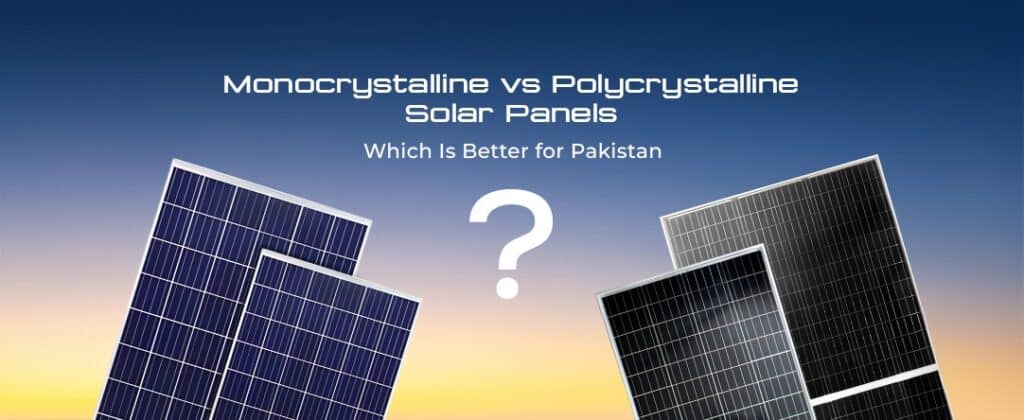
The monocrystalline versus polycrystalline debate has been part of Pakistan’s solar buying conversation since the market opened up in the early 2010s. For a long time, the answer was genuinely complicated: monocrystalline was better but significantly more expensive, and polycrystalline was good enough for most situations at a lower price point.
In 2026, the conversation has changed. Monocrystalline panels now account for over 95% of residential solar installations globally, and in Pakistan specifically, the price gap between monocrystalline and polycrystalline has narrowed to a point where the efficiency and performance advantages of monocrystalline almost always justify the incremental cost. Understanding why requires a clear look at what each technology actually delivers in Pakistan’s specific climate and rooftop context.
What the Two Technologies Actually Are
The Manufacturing Difference That Creates the Performance Gap
Monocrystalline panels are made from silicon grown into a single, continuous crystal structure using the Czochralski method. The uniform crystal lattice allows electrons to move with minimal resistance, which translates directly into higher conversion efficiency. In 2026, monocrystalline panels achieve 19% to 24% efficiency, with premium PERC and TOPCon variants reaching the upper end of that range.
Polycrystalline panels are made from multiple silicon crystal fragments melted together. The boundaries between crystals create electron flow resistance, reducing conversion efficiency to 15% to 18%. They are less expensive to manufacture because the production process is simpler and less wasteful of silicon material.
Both technologies convert sunlight to electricity, and both last 20 to 25 years with standard performance warranties. The practical differences emerge in three areas that matter specifically to Pakistani buyers: efficiency per square meter, heat performance, and long-term output degradation.
The Three Performance Differences That Matter in Pakistan
- Efficiency: How Much Power Per Square Meter of Roof
This is the most practically significant difference for Pakistani rooftops. A 400W monocrystalline panel occupies approximately the same physical area as a 350W polycrystalline panel. For a home with 40 square meters of usable roof space, monocrystalline panels generate approximately 15% to 20% more power from the same area.
In Pakistan’s urban context, where rooftops are shared with water tanks, air conditioning units, solar water heaters, and various household structures, available panel area is often genuinely limited. The best solar panels in Pakistan for limited rooftop space are consistently monocrystalline because they extract more generation capacity from each square meter available. Polycrystalline panels require approximately 12% to 15% more roof area to generate the same output as monocrystalline panels, which can mean the difference between fitting 10 panels and fitting 12 panels on a constrained rooftop.
- Heat Performance: Pakistan’s Summer Is the Deciding Factor
All solar panels lose efficiency as temperature rises. The rate of that loss is measured by the temperature coefficient, expressed as percentage efficiency loss per degree Celsius above 25°C.
Monocrystalline panels such as the MP 280W Bifacial Half-Cut Solar Panel have a temperature coefficient of approximately 0.35% per degree Celsius. Polycrystalline panels range from 0.40% to 0.45% per degree Celsius. This sounds like a small difference. In Pakistan’s summer climate, it is not.
On a July afternoon in Lahore or Karachi when the ambient temperature is 45°C, the panel surface temperature on a rooftop can reach 65°C to 70°C. At 70°C, which is 45°C above the standard test temperature of 25°C, a monocrystalline panel loses 45 x 0.35% = 15.75% of its rated output. A polycrystalline panel in the same conditions loses 45 x 0.42% = 18.9% of rated output. The difference of approximately 3 percentage points translates to real generation losses every afternoon from May through September when Pakistan’s cooling loads are highest and solar generation matters most.
Over a full Pakistani summer, monocrystalline panels generate approximately 3% to 5% more energy than polycrystalline panels of the same rated wattage installed in the same location. This advantage is built into every day’s generation without any additional cost or effort after installation.
- Long-Term Degradation: The 25-Year Picture
Quality monocrystalline panels degrade at approximately 0.3% to 0.4% per year. Quality polycrystalline panels degrade at 0.5% to 0.7% per year. A standard 25-year linear performance warranty guarantees 80% of rated power at year 25 for most panels, but the degradation rate within that warranty determines how much energy the panels actually generate each year.
At 0.35% annual degradation, a 550W monocrystalline panel generates approximately 502W in year 25. At 0.6% annual degradation, a 480W polycrystalline panel generates approximately 411W in year 25. The monocrystalline panel generates 8% to 10% more total energy over the 25-year lifespan from the slower degradation rate alone, before accounting for the original efficiency advantage.
Price Comparison in Pakistan 2026
Monocrystalline solar panels from quality brands including Max Power, Longi, Jinko, Canadian Solar, Trina, and JA Solar are available in Pakistan in 2026 at PKR 28 to PKR 40 per watt, depending on brand, efficiency tier, and order quantity. Polycrystalline panels are available at approximately PKR 22 to PKR 30 per watt for comparable quality.
The price gap is approximately 10% to 20% per watt. For a 10-panel system at 550W per panel (5,500W total), the monocrystalline premium over polycrystalline at mid-range pricing is approximately PKR 16,500 to PKR 55,000 for the panel array. Against a system generating 8% to 10% more energy over 25 years at current tariff rates, the payback on the monocrystalline premium is typically 1 to 2 years. The remaining 23 to 24 years of additional generation from the more efficient panels represents pure financial advantage.
When Polycrystalline Still Makes Sense
Polycrystalline panels remain a valid choice in two specific Pakistani contexts. First, large rural installations where rooftop or ground space is genuinely unlimited and the priority is minimizing upfront cost per kilowatt of installed capacity. In a 50 kW to 100 kW agricultural or rural installation with ample ground-mounting space, polycrystalline’s lower per-watt cost reduces total capital expenditure meaningfully. Second, very budget-constrained small systems where the priority is getting any solar backup in place at the lowest possible entry cost, with the expectation of future panel upgrades.
For every other Pakistani solar buyer in 2026, monocrystalline is the straightforward recommendation. The efficiency advantage, the heat performance advantage, the lower degradation rate, and the now-narrowed price gap all point in the same direction.
Frequently Asked Questions
Are monocrystalline solar panels worth the extra cost in Pakistan in 2026?
Yes, for the overwhelming majority of Pakistani solar buyers. The price gap between monocrystalline and polycrystalline has narrowed to 10% to 20% per watt in 2026, while the performance advantages, including higher efficiency per square meter, better heat performance in Pakistan’s climate, and slower long-term degradation, consistently offset the premium within 1 to 2 years of operation. The 25-year cumulative energy advantage of monocrystalline panels makes the payback calculation clearly favorable for any system intended to run for a decade or more.
Which solar panel brand is best for Pakistani climate conditions?
Longi, Jinko, Canadian Solar, Trina, and JA Solar are the Tier-1 monocrystalline panel brands most widely available in Pakistan in 2026, all with verifiable manufacturing certifications, 25-year performance warranties, and Pakistan-specific distributor availability. MaxPower carries a solar panel range, including monocrystalline options vetted for compatibility with its hybrid inverter lineup. The right brand within this group depends on your system capacity, current pricing availability, and whether the panels are certified for your DISCO’s net-metering technical requirements.
Do monocrystalline panels work better in Karachi’s humidity versus Punjab’s dry heat?
Monocrystalline panels perform well in both environments. In Karachi’s coastal humidity, the higher efficiency per panel means you need fewer panels for the same generation capacity, which reduces the total exposed glass area susceptible to salt haze soiling. Regular cleaning is important in both environments. In Punjab’s dry heat, the lower temperature coefficient of monocrystalline silicon is the relevant advantage, reducing the afternoon generation loss during the hottest months when cooling loads are highest.
What is the difference between monocrystalline, PERC, and TOPCon solar panels in Pakistan?
Standard monocrystalline panels achieve 19% to 21% efficiency. PERC (Passivated Emitter and Rear Cell) monocrystalline panels improve efficiency to 21% to 23% by adding a reflective rear layer that captures light that would otherwise pass through the cell. TOPCon (Tunnel Oxide Passivated Contact) panels achieve 22% to 25% efficiency through additional passivation engineering. Both PERC and TOPCon are monocrystalline technologies with incrementally higher efficiency and price. In Pakistan in 2026, standard PERC monocrystalline panels represent the mainstream quality tier and are widely available from Tier-1 brands.
How many monocrystalline panels do I need for a 5 kW solar system in Pakistan?
A 5 kW solar system in Pakistan using 550 W monocrystalline panels requires 10 panels (5,500 W nominal), which is a standard configuration for a medium-size residential installation. With 575W panels, 9 panels produce 5,175W, which is also a common 5 kW configuration. The exact count depends on your chosen panel wattage and the inverter’s MPPT voltage requirements. Max Power’s system design team specifies the correct panel count and string configuration based on your roof layout and inverter model.
Monocrystalline or Polycrystalline: Are You Still Asking the Question or Ready to Make the Right Call?
For Pakistan’s climate, roof space constraints, and 25-year generation economics, the answer in 2026 is monocrystalline for virtually every buyer who is serious about getting the most out of their solar investment. The technology is now priced close enough to polycrystalline that the performance case wins the comparison decisively.
Explore Max Power’s solar panel range to specify the right monocrystalline panels for your system size and roof layout.